
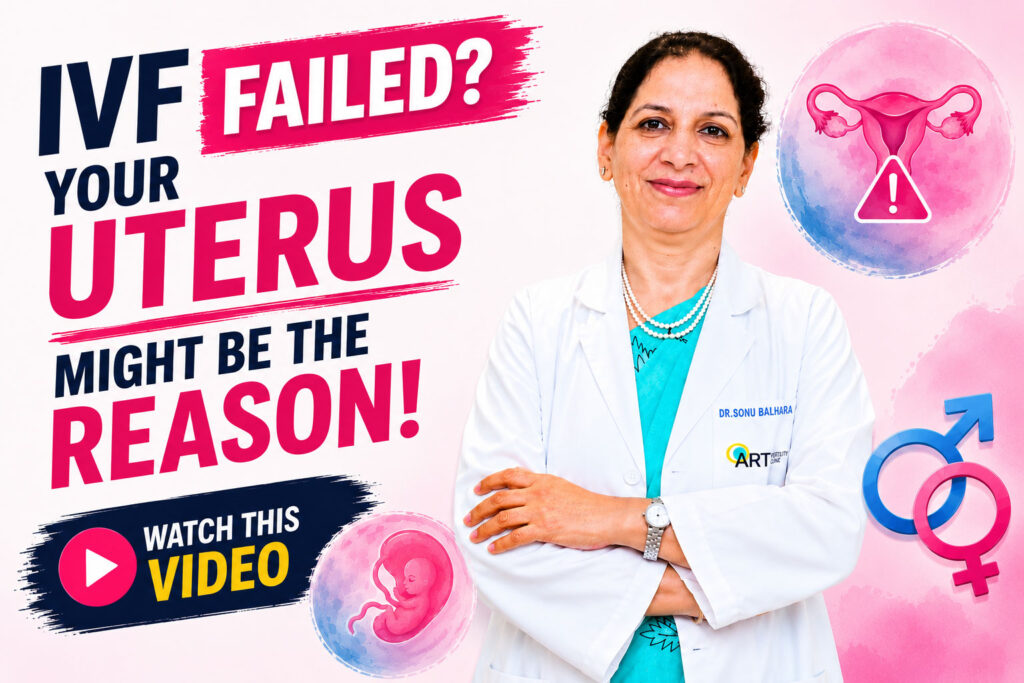
In IVF, two things must come together for a successful pregnancy: a good quality embryo and a healthy uterus. Most people know about embryo quality — but the uterus is equally important, and far less talked about.
Hysteroscopy is the procedure that allows a fertility specialist to look directly inside the uterus, assess its condition, and correct any problems that may be preventing pregnancy. Dr. Sonu Balhara, IVF & Fertility Expert and Director of ART Fertility Clinics, Sector 38, Gurugram, uses hysteroscopy as a key diagnostic and treatment tool — for patients preparing for IVF, for those who have experienced failed cycles, and for anyone with unexplained fertility challenges.
In her clinic video, Dr. Sonu Balhara explains it simply: “There are two important factors in IVF: the embryo and the uterus. Hysteroscopy is performed to assess the uterine cavity. By inserting the camera into the uterus, we are able to examine the cavity in detail.”
Watch Dr. Sonu Balhara demonstrate hysteroscopy: Watch on Instagram →
What Is Hysteroscopy?
Hysteroscopy is a minimally invasive procedure in which a thin, flexible instrument called a hysteroscope — fitted with a camera and a light source — is gently inserted through the cervix into the uterus. The camera transmits a live image to a screen, allowing the doctor to see the inside of the uterine cavity in real time.
There is no cutting, no stitches, and no general anaesthesia in most cases. It is performed as a day procedure — patients can typically return home the same day.
Why Is Hysteroscopy Done?
The uterine cavity needs to be in optimal condition for an embryo to implant and grow. Even when egg quality and sperm quality are excellent, a structural or surface problem inside the uterus can prevent implantation — or cause early miscarriage.
Hysteroscopy is recommended in the following situations:
- Before starting an IVF cycle — to check that the uterine cavity is normal and ready
- After a failed IVF cycle — to investigate why implantation did not occur
- After recurrent miscarriages — to identify any structural cause
- When an ultrasound shows a possible abnormality — such as a fibroid, polyp, or thickened lining
- To investigate unexplained heavy, painful, or irregular periods
- Before a frozen embryo transfer (FET) — to prepare the uterus optimally
What Can Hysteroscopy Detect and Treat?
Hysteroscopy is both a diagnostic and a therapeutic procedure — meaning Dr. Sonu Balhara can identify a problem and often correct it during the same procedure.
Uterine Polyps
Polyps are small, soft growths on the inner lining of the uterus (endometrium). They are very common and often cause no symptoms — but they can interfere with embryo implantation. Polyps are removed through hysteroscopy in a simple, targeted procedure.
Fibroids (Submucous Fibroids)
Fibroids that grow into the uterine cavity — called submucous or submucosal fibroids — can distort the shape of the cavity and disrupt implantation. Hysteroscopy allows these to be removed without open surgery.
Uterine Septum
A uterine septum is a band of tissue that divides the uterine cavity — a congenital abnormality that many women are unaware of until a fertility evaluation. It is associated with recurrent miscarriage and failed IVF. Hysteroscopy can correct this in a single procedure.
Intrauterine Adhesions (Asherman’s Syndrome)
Adhesions are bands of scar tissue that form inside the uterus — often following a previous surgery, infection, or D&C procedure. They reduce the space available for an embryo to implant. Hysteroscopy removes these adhesions and restores normal uterine anatomy.
Endometrial Assessment
Hysteroscopy allows direct visual assessment of the endometrium — the inner lining of the uterus. An irregular, thin, or inflamed lining may explain failed IVF cycles even when all other parameters are normal.
What Happens During the Procedure?
The procedure is typically performed in the first half of the menstrual cycle — after the period has ended and before ovulation — when the uterine lining is thinnest and the cavity is easiest to visualise.
- The patient lies in a standard gynaecological position
- A speculum is placed to gently open the vagina
- The hysteroscope is passed through the cervix — no incision is made
- The uterine cavity is expanded with a clear fluid to allow the camera to see clearly
- The doctor examines the entire cavity — the walls, the lining, and both fallopian tube openings
- If a polyp, fibroid, or adhesion is found, it can be removed during the same session
- The procedure usually takes 15 to 30 minutes
Is Hysteroscopy Painful?
Most patients experience mild cramping during and briefly after the procedure — similar to period pain. This usually resolves within a few hours.
For diagnostic hysteroscopy, local anaesthesia or mild sedation is often sufficient. For operative hysteroscopy — where tissue is being removed — a short general or regional anaesthetic may be used, depending on the extent of the procedure and patient preference.
Dr. Sonu Balhara discusses the most appropriate approach for each patient individually before the procedure.
Recovery After Hysteroscopy
- Most patients return home on the same day
- Mild spotting or cramping for 1–2 days is normal
- Normal activity can usually resume within 24–48 hours
- Sexual intercourse is usually avoided for 5–7 days
- A follow-up consultation is scheduled to review findings and discuss the next steps
Hysteroscopy Before IVF: Why It Makes a Difference
Several studies have shown that performing a hysteroscopy before an IVF cycle — particularly in women who have had a previous failed cycle — significantly improves implantation and pregnancy rates. The procedure improves the uterine environment and allows any correctable problem to be addressed before the embryo transfer.
At ART Fertility Clinics, Gurgaon, Dr. Sonu Balhara recommends hysteroscopy as part of a comprehensive pre-IVF workup for appropriate patients — based on clinical history, ultrasound findings, and previous treatment outcomes.
Hysteroscopy vs. Laparoscopy: What Is the Difference?
Hysteroscopy: looks inside the uterine cavity. The instrument is passed through the cervix — no external incision. Used to assess and treat the inside of the uterus.
Laparoscopy: looks outside the uterus, at the fallopian tubes, ovaries, and pelvic structures. Requires small incisions in the abdomen. Used to assess and treat endometriosis, blocked tubes, and ovarian cysts.
In some cases, both procedures are performed together to provide a complete picture of the pelvic and uterine anatomy.
Why Choose Dr. Sonu Balhara for Hysteroscopy in Gurgaon?
- 25+ years of experience in IVF and reproductive medicine
- MBBS & Diploma O&G (PGIMS Rohtak), DNB Obstetrics & Gynaecology (Army Hospital R&R, Delhi Cantt)
- Hysteroscopy available at ART Fertility Clinics, Sector 38, Gurugram
- Diagnostic and operative hysteroscopy performed in a single visit where appropriate
- Research on recurrent implantation failure (IFS National Conference, 2012) — directly relevant to uterine assessment
- Patients from 21+ countries including England, Nigeria, Iraq, Bangladesh, Japan and Singapore
- Video consultations available for international patients planning treatment
Watch Dr. Sonu Balhara demonstrate hysteroscopy live: Watch on Instagram →
Dr. Sonu Balhara | IVF & Fertility Expert | ART Fertility Clinics, Sector 38, Gurugram | Personal Clinic: Sector 46, Greenwood City, Gurugram | +91 9811409586 | sonubalharaivf.com
Conclusion
A healthy embryo needs a healthy uterus. Hysteroscopy is one of the most effective tools available to assess and optimise the uterine environment — and in many cases, to correct problems that would otherwise prevent pregnancy.
If you are preparing for IVF, have experienced a failed cycle, or have been told your uterus needs investigation — book a consultation with Dr. Sonu Balhara at ART Fertility Clinics, Sector 38, Gurugram. The right preparation makes all the difference.