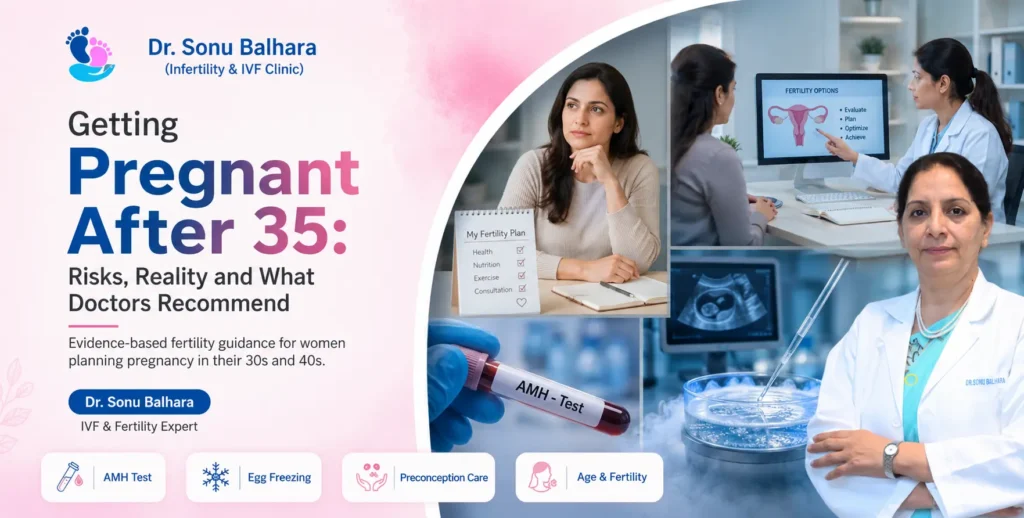
If you are in your 30s and thinking about having a baby, you have likely been told — by family, by the internet, by people who mean well — that your time is running out. Age and fertility is one of the most misunderstood topics in reproductive medicine, generating both unnecessary fear and dangerous complacency.
Dr. Sonu Balhara has been helping women navigate fertility across age groups for over 25 years. Trained at PGIMS Rohtak and Army Hospital R&R, Delhi Cantt (DNB Obstetrics & Gynaecology), and previously Senior Consultant at Artemis Hospital Gurgaon, she now leads ART Fertility Clinics at Sector 38, Gurugram. Her international patient base — which includes women from England, Bangladesh, Japan, Oman, South Africa, Singapore, Nigeria, Mauritius, Iraq and beyond — reflects the global relevance of this topic for women who have built careers and lives before turning to parenthood.
How Does Age Actually Affect Fertility?
Women are born with all the eggs they will ever have. Egg quantity and quality both decline with age — a gradual process that accelerates after 35 and more sharply after 40. This is not a myth. But the practical implications are more nuanced than most people are led to believe.
The decline does not happen overnight at 35. Monthly fertility begins declining in the late 20s, continues through the 30s, and becomes more clinically significant after 37–38. Many women conceive naturally in their late 30s; many require assistance; all benefit from knowing their individual fertility status early.
The AMH Test: The Most Important Test Over 30
The Anti-Müllerian Hormone (AMH) test is a blood test that accurately reflects ovarian reserve — how many eggs remain. Combined with an Antral Follicle Count (AFC) scan, it gives the clearest possible picture of a woman’s current fertility status.
Dr. Sonu Balhara recommends AMH testing for any woman over 30 who is planning a pregnancy in the next 1–3 years. Her own research at the 7th National Conference of the Indian Fertility Society (2011) examined the relationship between AMH and antral follicle counts in ovarian reserve assessment — making her particularly well-positioned to interpret these results in the context of personalised treatment.
Egg Freezing: Planning Ahead
Egg freezing (oocyte cryopreservation) allows women to preserve their eggs at their current age and quality for future use. It is increasingly chosen by women in their early-to-mid 30s who are not yet ready to conceive but want to protect their options.
Dr. Sonu Balhara offers egg freezing at ART Fertility Clinics, Gurgaon, and frequently advises women visiting from England, Bangladesh, Japan and Singapore to consider this when they are not yet ready to start a family but are aware of the age timeline.
Actual Risks vs. Common Exaggerations
What is medically supported:
- Gradual fertility decline accelerating post-35
- Higher incidence of chromosomal conditions in embryos — well managed with PGT genetic testing
- Modestly increased miscarriage risk with age
- Greater likelihood of needing fertility support to conceive
What is commonly exaggerated:
- That pregnancy after 35 is automatically ‘high risk’ — with appropriate antenatal care, outcomes are excellent
- That natural conception after 35 is impossible — many women conceive without treatment
- That IVF always fails after 40 — with personalised protocols and, where needed, donor eggs, outcomes remain good
Preconception Checklist for Women Over 30
- AMH + AFC test — ovarian reserve
- Thyroid function test
- Blood sugar and HbA1c
- Rubella immunity check
- Folic acid supplementation (at least 3 months before trying)
- BMI and weight review
Dr. Sonu Balhara | IVF & Fertility Expert | ART Fertility Clinics, Sector 38, Gurugram | +91 9811409586 | sonubalharaivf.com
Conclusion
Age is a factor in fertility — a real one — but not a verdict. Women in their 30s and 40s are achieving successful pregnancies every day with the right medical support. Book a preconception consultation with Dr. Sonu Balhara at ART Fertility Clinics, Gurugram, and start with an honest, evidence-based picture of your fertility today.