This is the question Dr. Sonu Balhara hears most often. A couple walks in — they have been trying for months, sometimes years — and the first thing they say is: “Doctor, we are doing everything right. Why is it not happening?”
It is the right question to ask. And asking it early — rather than waiting and hoping month after month — makes an enormous difference to the outcome.
In a recent Instagram video, Dr. Sonu Balhara, IVF and Infertility Specialist at ART Fertility Clinics, Gurgaon, addressed this exact question directly. She explained that there are several possible reasons a couple may not be conceiving — and crucially, that most of them are detectable and treatable.
Watch Dr. Sonu Balhara explain this in her own words: https://www.instagram.com/p/DYloDyeTMc9/?hl=en — ‘Most fertility problems are treatable. The good news is we can make a couple pregnant.’
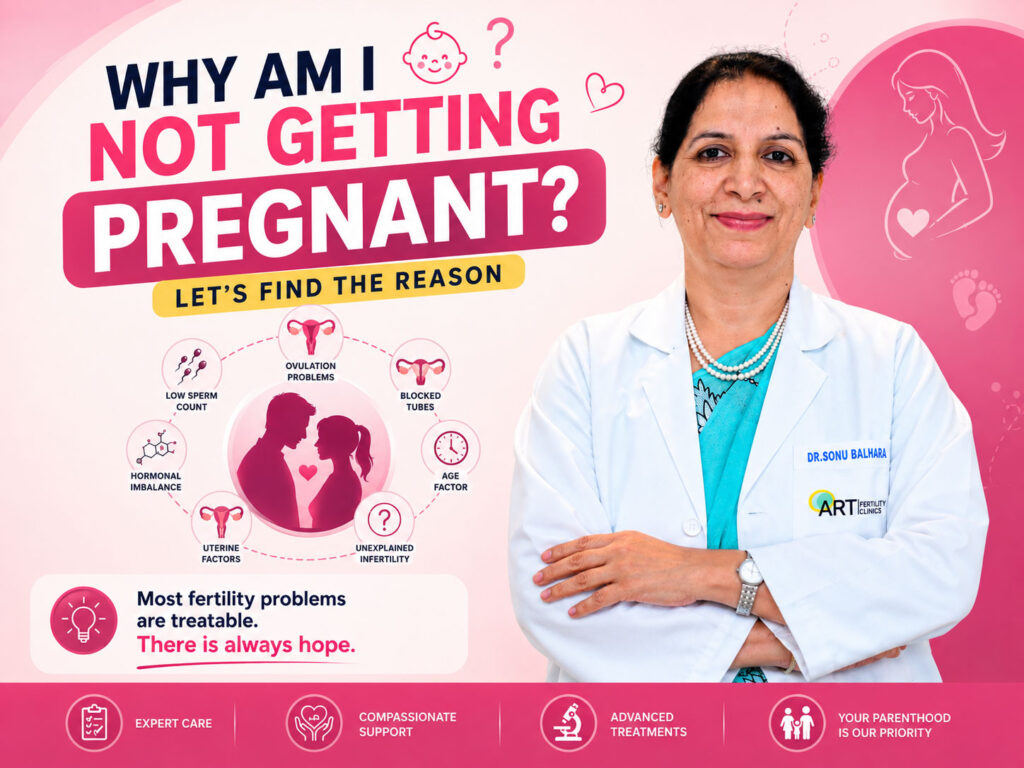
The Most Common Reasons You May Not Be Getting Pregnant
Infertility is defined as the inability to conceive after 12 months of regular, unprotected intercourse — or 6 months if the woman is over 35. It is more common than most people realise: approximately 1 in 6 couples faces some difficulty conceiving. Understanding the cause is the first step toward solving it.
- Ovulation Problems
Ovulation is the process by which a mature egg is released from the ovary. If ovulation is irregular, infrequent, or absent, conception cannot occur naturally. Conditions like PCOS (Polycystic Ovary Syndrome) are the most common cause of ovulation-related infertility in women. Symptoms include irregular periods, very light or very heavy periods, or no periods at all.
The good news: ovulation problems respond very well to treatment. From simple lifestyle changes to ovulation induction tablets to IVF, there are multiple effective pathways.
- Blocked or Damaged Fallopian Tubes
The fallopian tubes carry the egg from the ovary to the uterus and are where fertilisation naturally takes place. If one or both tubes are blocked — due to previous infection, endometriosis, or surgery — the egg and sperm cannot meet.
Blocked tubes often cause no symptoms at all, which is why they are frequently missed until a couple undergoes a fertility evaluation. A simple test called an HSG (Hysterosalpingography) can identify tube blockages quickly.
- Low Sperm Count or Poor Sperm Quality
Male factor infertility is involved in approximately 40–50% of all cases where a couple struggles to conceive — yet it is among the last things evaluated in most households. Low sperm count, poor motility (movement), abnormal shape, or DNA fragmentation can all prevent fertilisation.
A semen analysis — a painless, simple test — is one of the first investigations Dr. Sonu Balhara recommends for both partners at the first consultation. It takes one visit and can completely redirect the treatment approach.
- Hormonal Imbalance
Hormones control almost every aspect of the reproductive process — from egg development to ovulation to the preparation of the uterine lining for implantation. Imbalances in hormones such as FSH, LH, prolactin, thyroid hormones, or androgens can disrupt this chain at multiple points.
A basic hormonal blood panel is part of the standard fertility workup and can identify issues that are often easily corrected with medication.
- Age-Related Decline in Fertility
A woman’s egg quantity and quality naturally decline with age — gradually in the late 20s and 30s, and more significantly after 37–38. This does not mean conception is impossible, but it does mean that time matters, and early evaluation is important.
The AMH (Anti-Müllerian Hormone) test gives an accurate picture of current ovarian reserve and helps Dr. Sonu Balhara recommend the most appropriate treatment for each woman’s age and egg reserve.
- Unexplained Infertility
In approximately 10–15% of cases, all standard tests come back normal — and yet conception is not occurring. This is called unexplained infertility. It can be one of the most frustrating diagnoses to receive, but it is not hopeless.
As Dr. Sonu Balhara explains in her video: “There can be certain factors which are undetectable — which we cannot detect. But we do some basic tests, and we can help patients. Most factors are treatable, and we can make a couple pregnant.”
In unexplained infertility, treatments such as IUI or IVF are often highly effective even without a clear diagnosis.
- Uterine and Structural Factors
Fibroids, polyps, a thin uterine lining, or a structural abnormality (such as a septum) can prevent a fertilised egg from implanting successfully. These conditions are diagnosable with an ultrasound or hysteroscopy and are frequently correctable.
When Should You Get Evaluated?
Dr. Sonu Balhara recommends a fertility evaluation if:
- You are under 35 and have been trying for 12 months without success
- You are 35 or older and have been trying for 6 months
- You have irregular or absent periods
- You have a known condition such as PCOS, endometriosis, or thyroid disorder
- You or your partner has had a previous infection, surgery, or fertility concern
- You have experienced recurrent miscarriages
One important point: both partners should be evaluated at the same time. Evaluating only the woman first — and adding the male assessment later if the female tests are normal — is an approach that wastes months. Dr. Sonu Balhara’s first consultation always includes both partners.
What Does a Basic Fertility Evaluation Include?
For women:
- Hormonal blood tests: FSH, LH, AMH, Prolactin, Thyroid, Oestradiol
- Pelvic ultrasound: antral follicle count, uterus and ovary check
- HSG (fallopian tube test) — if indicated
- Blood sugar, vitamin D, and general health panel
For men:
- Semen analysis: count, motility, morphology, volume
- Hormonal tests if semen analysis is abnormal
- DNA fragmentation test if required
The Most Important Thing to Know
Most couples who walk into Dr. Sonu Balhara’s clinic worried, confused, and exhausted — leave with a clear diagnosis, a clear plan, and genuine hope. The majority of fertility problems are treatable. The key is not to wait.
As Dr. Sonu Balhara puts it in her video: “The good thing is most of the factors are treatable, and we can make a couple pregnant.” That is not a marketing promise — it is the clinical reality for the overwhelming majority of patients who seek timely help.
Why Choose Dr. Sonu Balhara for Your Fertility Evaluation in Gurgaon?
- 25+ years of experience in IVF and reproductive medicine
- DNB Obstetrics & Gynaecology — Army Hospital R&R, Delhi Cantt
- Research on ovarian reserve (IFS National Conference, 2011) and recurrent implantation failure (IFS, 2012)
- Previously Senior Consultant, Artemis Hospital Gurgaon (2010–2023)
- Currently Director, ART Fertility Clinics, Sector 38, Gurugram
- Evening consultations at personal clinic, Sector 46, Greenwood City, Gurugram
- Patients from 21+ countries including England, Nigeria, Iraq, Bangladesh, Japan and Singapore
- Video consultations available for international and outstation patients
Watch the full video on Instagram: https://www.instagram.com/p/DYloDyeTMc9/?hl=en | Follow Dr. Sonu Balhara @drsonubalharaivf for more Q&A videos in this series.
Dr. Sonu Balhara | IVF & Fertility Expert | ART Fertility Clinics, Sector 38, Gurugram | Personal Clinic: Sector 46, Greenwood City, Gurugram | +91 9811409586 | sonubalharaivf.com
Conclusion
Not getting pregnant is not a failure — it is a signal. A signal that something needs attention, investigation, and the right kind of care. Most of the time, that care exists and it works.
If you have been trying to conceive without success, do not wait another cycle hoping it will happen on its own. Book a fertility evaluation with Dr. Sonu Balhara — at ART Fertility Clinics, Sector 38, Gurgaon, or at her personal clinic in Sector 46, or via video consultation from anywhere in the world.