
If your IVF cycle has just failed, you are living through a kind of grief that is difficult to put into words. The hope built over weeks of injections, scans, egg retrievals, and waiting has been replaced by a deep, disorienting loss.
Dr. Sonu Balhara has sat across from hundreds of couples at this exact moment — from India, from England, from Nigeria, from Iraq, from Bangladesh, from Japan. Her message is consistent and evidence-based: a failed IVF cycle is not the end of your story. It is clinical data — important data that tells both you and your doctor what needs to change in the next attempt.
Dr. Sonu Balhara’s published research on immunomodulators in recurrent implantation failure (Indian Fertility Society, 8th National Conference, 2012) makes her particularly equipped to investigate why cycles fail and what to do differently. This is not a doctor who simply repeats the same protocol — she investigates, adjusts, and improves.
First: Give Yourself Permission to Grieve
Before any medical conversation, it matters to say this: a failed IVF cycle is a real loss. Do not rush past it. Allow yourself and your partner at least a few weeks before making decisions about what comes next. Speak to a counsellor if it helps. Be gentle with yourselves.
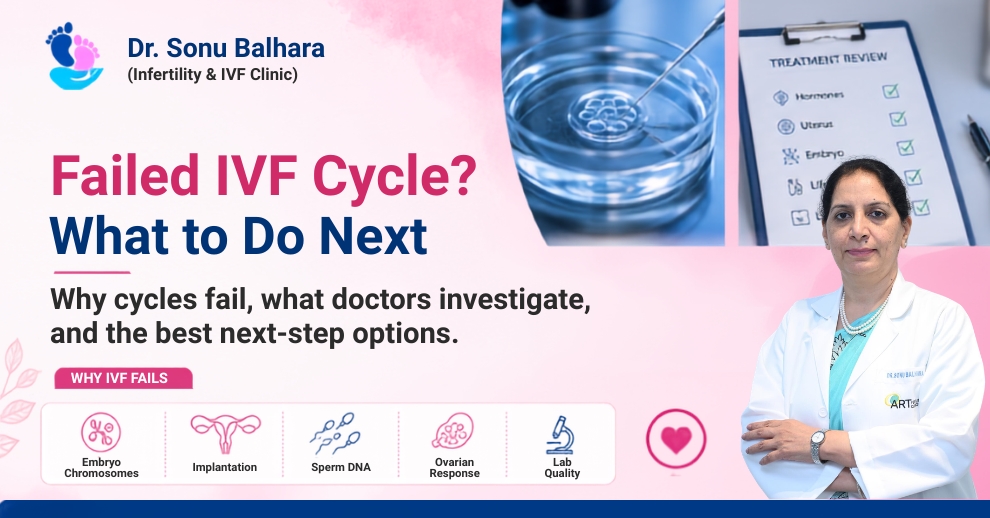
Why Do IVF Cycles Fail? The Clinical Reasons
1. Chromosomal Problems in the Embryo
The single most common reason for IVF failure. Most embryos that do not implant carry chromosomal abnormalities that prevent normal development. This is often age-related and is not caused by anything the patient did or did not do.
2. Implantation Failure
A good quality embryo still requires a receptive uterine environment. Thin endometrial lining, uterine polyps, fibroids, or immune system factors can prevent implantation even with an excellent embryo.
3. Ovarian Response
If stimulation produced few eggs, the number of embryos available for selection is limited — reducing the statistical probability of a successful transfer.
4. Sperm DNA Fragmentation
Standard semen analysis does not detect DNA damage in sperm. This is a significant hidden factor in many unexplained IVF failures, and one that Dr. Sonu Balhara specifically investigates after a failed cycle.
5. Laboratory Conditions
The quality of the culture environment, incubator stability, and embryologist skill all influence embryo development. This is one reason why clinic selection matters profoundly — not all IVF laboratories are equal.
What Dr. Sonu Balhara Investigates After a Failed Cycle
- Day-by-day embryo development records and grading
- Endometrial receptivity assessment — ERA test if recurrent failure
- Sperm DNA fragmentation test
- Immunological investigation for recurrent implantation failure
- Complete protocol review — stimulation doses, trigger timing, transfer approach, luteal phase support
How Success Rates Change With Subsequent Cycles
This is perhaps the most important fact for couples after a failed cycle: IVF success is cumulative. Each cycle, with appropriate protocol adjustments, improves the probability of the next.
- After 2 cycles: Cumulative success rate increases substantially
- After 3 cycles: Women under 38 regularly see cumulative success rates of 65–80%
- Protocol changes between cycles — based on careful review — frequently produce dramatically better embryo quality
Advanced Options After a Failed Cycle
PGT-A: Preimplantation Genetic Testing
Testing embryos for chromosomal normality before transfer substantially increases the probability of selecting a viable embryo. Strongly recommended for women over 35 or after unexplained implantation failure.
Frozen Embryo Transfer (FET)
If embryos from a previous cycle were successfully frozen, a FET with an optimised uterine preparation protocol frequently achieves better outcomes than the original fresh transfer.
Donor Eggs
For women with significantly diminished ovarian reserve or poor egg quality, donor egg IVF offers the highest success rates of any treatment option. This is not a last resort — it is a specific, highly effective solution for a specific problem.
Second Opinions: You Are Entitled to Ask
Dr. Sonu Balhara regularly sees patients who have experienced failed cycles elsewhere — at other clinics in India, or internationally from England, Nigeria, Iraq, Bangladesh, and South Africa. A thorough, independent review of a failed cycle by an experienced specialist can identify factors that were missed and open new treatment pathways.
Dr. Sonu Balhara | IVF & Fertility Expert | ART Fertility Clinics, Sector 38, Gurugram | +91 9811409586 | <ahref=”https://sonubalharaivf.com/” target=”_main”>sonubalharaivf.com
Conclusion
A failed IVF cycle is painful — but it is not a verdict. With a thorough clinical review, an adjusted protocol, and the right specialist by your side, the path to parenthood remains open. Book a consultation with Dr. Sonu Balhara at ART Fertility Clinics, Gurugram — in person or by video call.