
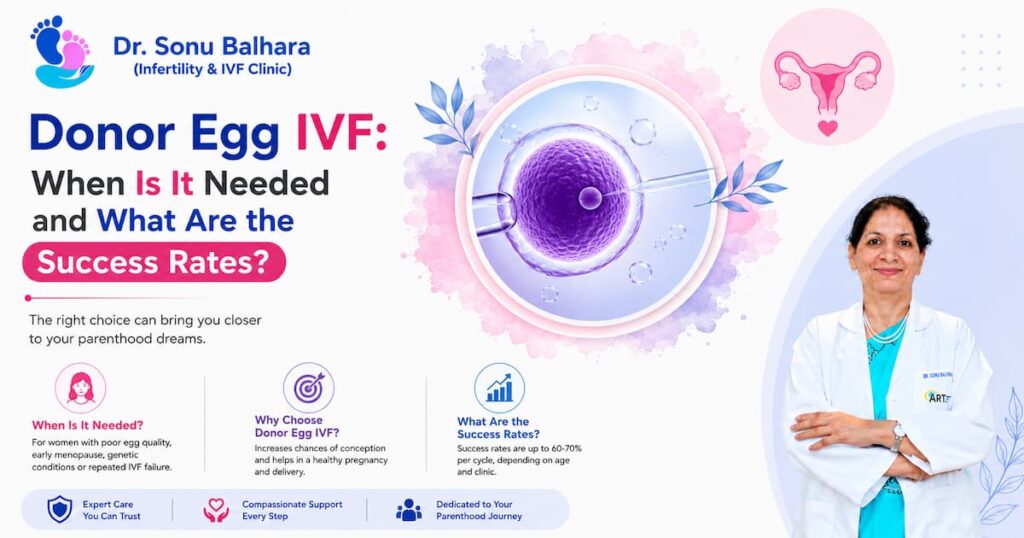
For some couples, the path to parenthood leads to donor egg IVF. This can feel like a difficult moment — but for many people, it is the step that finally brings them their baby.
Donor egg IVF has the highest success rates of any IVF treatment. And in India, it is both accessible and legal — with a clear framework under the ART Regulation Act.
Dr. Sonu Balhara, IVF & Fertility Expert at ART Fertility Clinics, Gurugram, regularly treats patients who need donor egg IVF — from India and internationally, including patients from England, Nigeria, Iraq, Afghanistan, and other countries where donor egg treatment may be more restricted or significantly more expensive.
What Is Donor Egg IVF?
In donor egg IVF, eggs from a carefully screened donor are fertilised with the partner’s (or donor) sperm in the laboratory. The resulting embryo is then transferred into the intended mother’s uterus. The intended mother carries and delivers the baby.
The child is genetically related to the sperm provider — not to the intended mother. The intended mother is the biological mother in every other sense — she carries the pregnancy, gives birth, and is the legal mother.
Who Needs Donor Egg IVF?
Poor egg quality
When a woman’s own eggs are of very poor quality — even after multiple IVF cycles — fertilisation and embryo development remain unsuccessful. Donor eggs offer a completely fresh start with high-quality eggs.
Very low or zero ovarian reserve
When AMH is extremely low or the ovaries are no longer producing eggs — whether due to age, previous surgery, or premature ovarian insufficiency — donor eggs are the most reliable path forward.
Premature ovarian insufficiency (early menopause)
Some women stop producing eggs much earlier than expected — in their 20s or 30s. This can happen spontaneously or due to medical treatment such as chemotherapy. Donor egg IVF gives these women the opportunity to carry a pregnancy.
Genetic conditions
When a woman carries a serious genetic condition that she does not wish to pass on — and PGT (genetic testing of embryos) is not suitable — donor eggs may be recommended.
Repeated failed IVF with own eggs
After several failed IVF cycles where the embryo quality has been consistently poor, switching to donor eggs often dramatically improves the outcome.
Women over 43 to 45
At this age, egg quality has typically declined significantly. While some women do conceive with their own eggs, donor egg IVF offers considerably higher success rates.
What Are the Success Rates?
Donor egg IVF has consistently the highest success rates of any fertility treatment — because the eggs come from young, healthy, thoroughly screened donors, typically aged 23 to 35.
- Success rates per embryo transfer: 40 to 55 percent (live birth rate per transfer, per national registry data)
- Cumulative success across multiple cycles is significantly higher than a single cycle — exact figures vary by clinic, patient age, and embryo quality
- These rates remain high regardless of the intended mother’s age — because it is the donor’s egg quality that determines the embryo
This is why a woman of 44 using donor eggs may have a significantly higher chance of pregnancy than a woman of 38 using her own eggs with poor quality.
How Are Donors Selected?
In India, egg donation is anonymous. Donors are young, healthy women who go through an extensive screening process:
- Age between 23 and 35
- Full medical history and physical examination
- Blood tests for infections, hormonal profile, and genetic conditions
- Psychological assessment
- Matching of physical characteristics with the intended mother where possible
At ART Fertility Clinics, donors are screened according to international standards. Dr. Sonu Balhara ensures that every donor meets strict medical and ethical criteria before being included in the programme.
What Does the Process Look Like?
The intended mother’s uterus is prepared with hormone medication to make the lining receptive. The donor undergoes egg retrieval after ovarian stimulation. The eggs are fertilised with sperm. The embryo is transferred to the intended mother.
If the intended mother has a regular menstrual cycle, synchronisation between donor and recipient is needed. If not — as in early menopause — hormone replacement is used to prepare the uterus directly.
What About the Legal and Emotional Side?
Legal
India’s ART (Assisted Reproductive Technology) Regulation Act governs donor egg treatment. Donation is anonymous. The intended mother is the legal mother of the child from birth. There is clear legal protection for all parties. Under the ART Act 2021 and ART Notification 2023: egg donors must be ever-married women aged 23 to 35, with at least one living child aged 3 or above; a donor may donate only once in her lifetime; no more than 7 eggs retrieved per donation; one donor’s eggs go to one couple only; relatives cannot donate eggs; commercial egg sale is prohibited. ART services are available to married couples or ever-married single women (widowed or divorced).
Emotional
Deciding to use donor eggs is a deeply personal journey. Many couples go through a period of grief — for the genetic connection they hoped for — before reaching acceptance and excitement. This is completely normal.
Dr. Sonu Balhara discusses this openly with her patients. She does not rush the decision. When a couple is ready, she helps them move forward with full information and emotional support.
Dr. Sonu Balhara | IVF & Fertility Expert | ART Fertility Clinics, Sector 38, Gurugram | Personal Clinic: Sector 46, Greenwood City, Gurugram | +91 9811409586 | sonubalharaivf.com
Conclusion
Donor egg IVF is not giving up — it is choosing a different path to the same destination. For many couples, it is the treatment that finally works. The baby who comes from this journey is no less their child.
If you have been told donor eggs may be needed, or if you are exploring your options after failed IVF cycles — book a consultation with Dr. Sonu Balhara at ART Fertility Clinics, Sector 38, Gurugram. She will give you honest, compassionate guidance on whether donor egg IVF is right for you.
