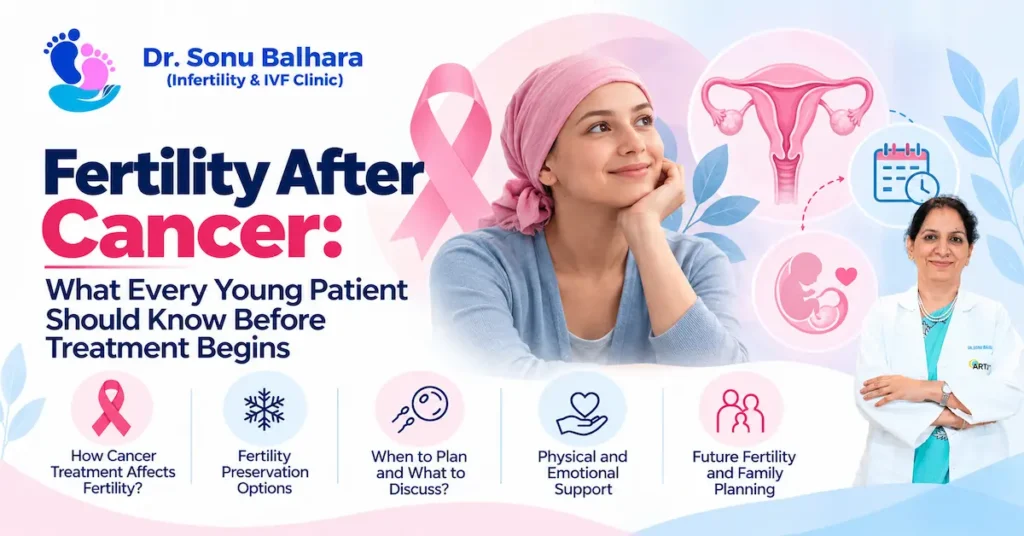
A cancer diagnosis is devastating. For younger patients — those who have not yet completed their families — the question of fertility after cancer adds another dimension of fear and uncertainty. Will cancer treatment affect my ability to have children? Should I do something about it now, before treatment starts?
Dr. Sonu Balhara, IVF & Fertility Expert at ART Fertility Clinics, Gurugram, has guided patients through this process, including those from Nigeria, Sudan, Liberia, Tajikistan, Kazakhstan, and Uzbekistan, where fertility preservation awareness is still limited. This blog provides a factual, evidence-based guide.
How Cancer Treatment Affects Fertility
Chemotherapy
Alkylating agents (cyclophosphamide, busulfan, chlorambucil, melphalan) and platinum compounds are the most gonadotoxic (harmful to the gonads). They can reduce the number of eggs remaining in the ovaries (ovarian reserve), cause premature ovarian insufficiency (early menopause), and damage sperm-producing cells in men. The impact depends on the specific agent, the dose, and the patient’s age and baseline ovarian reserve.
Radiation therapy
Pelvic radiation directly affects the ovaries and uterus. Total body irradiation (used in bone marrow transplants) is particularly damaging. Brain radiation affecting the hypothalamus-pituitary axis can disrupt hormonal control of ovulation. In men, radiation to the testes suppresses sperm production.
Surgery
Surgery to remove the ovaries (oophorectomy), uterus (hysterectomy), or cervix (radical trachelectomy) directly affects fertility potential. Some fertility-sparing surgical approaches are available for certain early-stage cancers.
Fertility Preservation Options — Before Cancer Treatment
The window before chemotherapy or radiation begins is critical. Once treatment starts, the options narrow significantly. ASCO (American Society of Clinical Oncology) updated their fertility preservation guidelines in March 2025 — the most comprehensive update in over a decade.
Embryo cryopreservation (freezing embryos)
The most established option for women who have a partner or wish to use donor sperm. Ovarian stimulation takes 10–14 days, eggs are retrieved, fertilised, and the resulting embryos are frozen. Success rates for thaw-and-transfer are well-established. This is the most effective method for future pregnancy.
Egg (oocyte) cryopreservation
For women without a partner, eggs can be frozen instead of embryos. Vitrification technology has significantly improved outcomes. The ASCO 2025 guidelines now classify egg freezing as a standard (no longer experimental) preservation option.
Ovarian tissue cryopreservation
A portion of the ovary is removed and frozen. After cancer treatment ends and the patient is declared cancer-free, the tissue is re-transplanted. This option is particularly valuable for patients who cannot delay cancer treatment for stimulation, and for pre-pubertal girls. The ASCO March 2025 update formally classified ovarian tissue cryopreservation as no longer experimental.
For men: sperm cryopreservation
Sperm freezing is straightforward and must be done before chemotherapy or radiation begins. ASCO Post (February 2026) reports sperm cryopreservation success rates of approximately 95% with modern techniques. The ASCO 2025 guideline explicitly states that all young male cancer patients should be offered sperm banking before gonadotoxic treatment, regardless of fertility plans.
GnRH agonist co-treatment during chemotherapy
Using a GnRH agonist during chemotherapy may help protect the ovaries by suppressing their activity. The evidence on whether this truly preserves fertility (versus merely suppressing periods during chemotherapy) is still debated — but it is widely used as an adjunct, particularly when other preservation options are not feasible. ASCO 2025 notes it is an option but not a substitute for established methods.
A New Addition: ASCO 2025 on Fertility Preservation in Survivorship
A significant development in the March 2025 ASCO update: for the first time, ASCO explicitly recommended that fertility preservation be discussed and offered not only before cancer treatment, but also during survivorship care — for survivors who did not have the opportunity to preserve fertility before treatment, or whose preserved fertility material has not been used. This is a major shift in clinical practice.
After Cancer Treatment: What Are the Options?
For survivors who preserved fertility material before treatment:
- Thaw and transfer of frozen embryos — most likely to succeed
- Thaw of frozen eggs — fertilise and transfer
- Reimplantation of frozen ovarian tissue — specialist procedure
For survivors who did not preserve fertility:
- If residual ovarian function remains: IVF may still be possible
- If ovarian failure has occurred: donor egg IVF
- If the uterus is intact but ovaries are absent: donor eggs + own uterus
- Surrogacy (gestational carrier): where uterus has been removed, in appropriate legal contexts
When Should Fertility Preservation Be Discussed?
Ideally, immediately after a cancer diagnosis — before any treatment decision is finalised. Oncologists are increasingly aware of this, and many now refer patients proactively to fertility specialists. However, some referrals still do not happen. If you or a family member has been diagnosed with cancer and is of reproductive age, ask your oncologist specifically: “What will this treatment do to my fertility, and what are my options right now?”
Dr. Sonu Balhara’s Practice
At ART Fertility Clinics, Gurugram, Dr. Sonu Balhara works with oncology teams to provide rapid fertility preservation consultation before cancer treatment begins — including, where needed, urgent egg or embryo freezing within the narrow pre-treatment window. For cancer survivors who did not preserve fertility, she conducts a thorough assessment of residual ovarian reserve and discusses all available options.
Conclusion
A cancer diagnosis should not automatically mean the end of the possibility of having a child. With rapid, specialist fertility preservation before treatment, and careful management after, many cancer survivors go on to achieve successful pregnancies. The critical step is acting quickly — and knowing your options.
If you or a loved one has received a cancer diagnosis and wishes to discuss fertility preservation, contact Dr. Sonu Balhara at ART Fertility Clinics, Sector 38, Gurugram (also available for WhatsApp consultation at +91 9811409586) or her personal clinic in Greenwood City, Sector 46.
Dr. Sonu Balhara | IVF & Fertility Expert | | +91 9811409586 | sonubalharaivf.com