
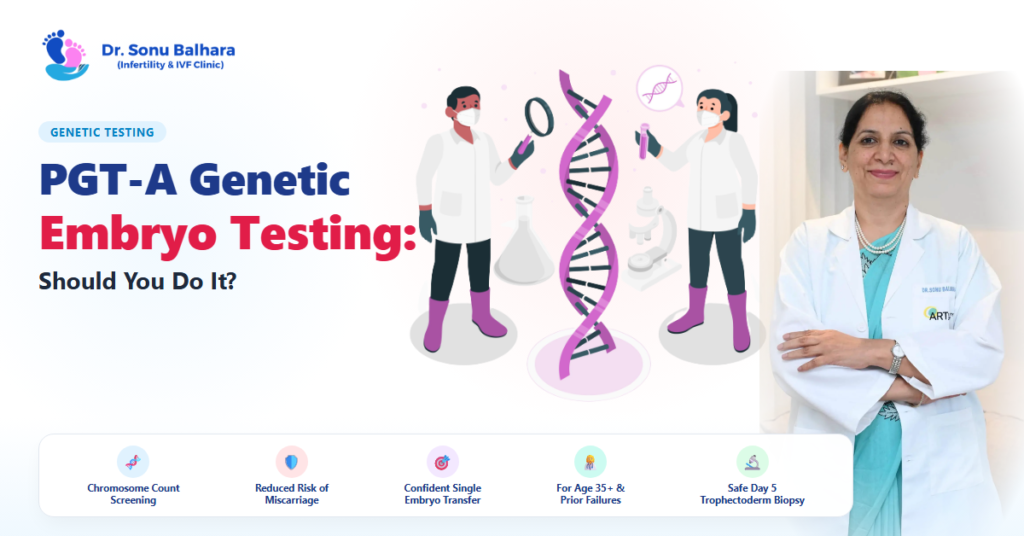
Preimplantation Genetic Testing for Aneuploidies (PGT-A) is one of the most discussed and debated topics in modern IVF. The premise is appealing: test your embryos for chromosomal abnormalities before transfer, select only normal ones, and reduce miscarriage rates while improving the efficiency of IVF. But the reality is more nuanced.
Dr. Sonu Balhara believes in evidence-based decision-making and helps couples understand when PGT-A genuinely helps — and when it may not.
What Is PGT-A?
PGT-A involves biopsying a few cells from a blastocyst-stage embryo (Day 5–6) and analysing them using Next Generation Sequencing (NGS) to identify aneuploidies — embryos with an abnormal number of chromosomes (too many or too few). The most common aneuploidies cause implantation failure, miscarriage, or genetic syndromes (e.g., Down syndrome = trisomy 21).
Previously known as PGS (preimplantation genetic screening), the name changed to PGT-A in 2017 following international consensus to better reflect that this is not a “screen” in the traditional sense.
The Evidence: ASRM 2024 Committee Opinion
ASRM’s 2024 updated Committee Opinion on PGT-A (asrm.org) provides the most current evidence-based guidance:
Who Benefits Most:
Women aged 35 and over: Higher proportion of aneuploid embryos; PGT-A identifies euploid (chromosomally normal) embryos and may improve IVF efficiency
Recurrent implantation failure (RIF): 2 or more failed transfers of good-quality embryos
Recurrent pregnancy loss (RPL): 2 or more miscarriages. PGT-A can reduce miscarriage rate by identifying and not transferring aneuploid embryos (ASRM 2024)
Severe male factor: Higher rates of sperm aneuploidy correlate with higher rates of embryo aneuploidy
Where Evidence Is Limited or Uncertain:
Women under 35 with normal ovarian reserve: Most embryos are euploid anyway; PGT-A may not improve live birth rates per couple but reduces number of transfers needed
All-comers IVF: A 2020 Cochrane review (Cornelisse et al.) found no evidence of benefit in unselected IVF populations from PGT-A, with insufficient data to rule out harm
Mosaic embryos: PGT-A may identify mosaic embryos (some aneuploid cells, some normal) — these are not necessarily non-viable, and de-selecting them may discard potentially successful embryos (ASRM 2024 notes this remains an area of active research)
The Mosaicism Issue: A Critical Nuance
Modern high-resolution NGS can detect mosaicism — where some embryonic cells are chromosomally normal and others are not. ASRM’s 2024 opinion notes that:
Some mosaic embryos do result in healthy pregnancies and healthy children
The degree of mosaicism matters: low-level mosaicism (<50% abnormal cells) is associated with better outcomes than high-level mosaicism
Discarding all mosaic embryos may leave some couples with no embryos to transfer
Transfer of mosaic embryos should follow PGDIS (Preimplantation Genetic Diagnosis International Society) position guidelines and requires detailed counselling
The Biopsy: Safety and Accuracy
PGT-A biopsy removes approximately 5–10 cells from the trophectoderm (outer cell layer) of the blastocyst — not from the inner cell mass that becomes the foetus. When performed by experienced embryologists, biopsy does not appear to reduce implantation potential in vitrified-warmed embryos (ASRM 2024).
Accuracy of modern NGS-based PGT-A is approximately 97–99% for detecting whole-chromosome aneuploidy. However, the biopsy tests only the cells sampled — a process called “confined placental mosaicism” or biological variation within the embryo means a small percentage of results do not perfectly represent the whole embryo.
Practical Considerations
Cost: PGT-A adds significant cost to an IVF cycle (typically ₹50,000–1,20,000 per cycle in India, depending on the number of embryos tested) — this is in addition to IVF costs
All embryos must be frozen during testing: PGT-A inherently requires FET
Genetic counselling: ideally before the cycle, to understand what results mean and what happens with different embryo outcomes
Not all embryos reach blastocyst: couples with few embryos may end up with no euploid embryos to transfer — PGT-A does not create normal embryos, it identifies them
Who Should Seriously Consider PGT-A?
Based on ASRM 2024 and ESHRE PGT-A guidance, Dr. Sonu Balhara most commonly recommends PGT-A for:
Women ≥38 with multiple embryos: Increases efficiency — reduces number of transfers before success
Two or more miscarriages: Particularly if genetic cause not yet identified
Two or more failed IVF transfers: After ruling out uterine and other causes
Severe male factor (sperm): where ICSI alone may not fully overcome sperm DNA quality
donor egg recipients who want genetic reassurance
Dr. Sonu Balhara‘s View
“PGT-A is not for everyone, and I never push it routinely. For the right patients — women over 38, couples with repeated losses or failed transfers — it can meaningfully reduce the number of transfer attempts and miscarriages. For younger women with no history of losses or failure, the evidence does not yet clearly show it improves the chance of ultimately taking home a baby. I explain all of this in detail before anyone decides.” — Dr. Sonu Balhara, Nova IVF Fertility, Gurugram
References
- ASRM Committee Opinion (2024). The Use of Preimplantation Genetic Testing for Aneuploidy. asrm.org
- Cornelisse S et al. (2020). PGT-A in IVF/ICSI. Cochrane Database of Systematic Reviews
- PGDIS Position Statement on Transfer of Mosaic Embryos (2021). Journal of Assisted Reproduction and Genetics
Schedule a Consultation with Dr. Sonu Balhara
Whether you are exploring IVF options, considering embryo transfer protocols, or seeking a second opinion on fertility treatment in Gurgaon, Dr. Sonu Balhara provides personalized, compassionate, and transparent care backed by 25+ years of clinical excellence.
📍 Clinic: Nova IVF Fertility, Plot No. 522, near DLF Mega Mall, Sector-27, Gurugram
📞 Phone / WhatsApp: +91 9811409586 |
🌐 Website: sonubalharaivf.com