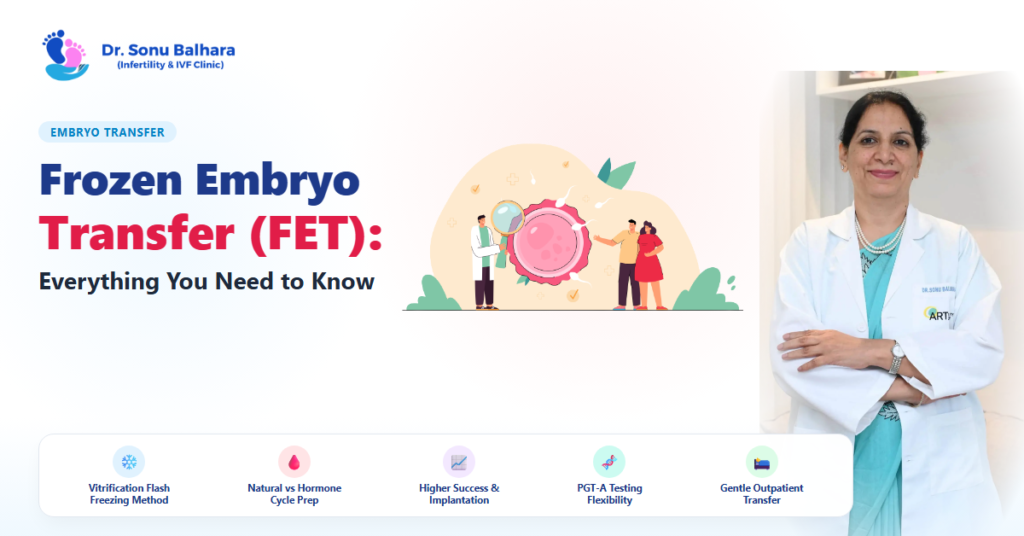
The landscape of IVF has changed dramatically over the past decade. Today, frozen embryo transfer (FET) has become more common than fresh embryo transfer in leading clinics worldwide — and for good reasons. If you have been told your embryos will be frozen and transferred in a later cycle, this is not a setback. It may actually be the smarter choice.
Dr. Sonu Balhara explains the science, the evidence, and what patients at Nova IVF Fertility, Sector-27, Gurugram can expect.
What Is Frozen Embryo Transfer?
After egg collection and fertilisation in IVF, embryos are cultured in the laboratory for 3–5 days. In a fresh transfer, one or more embryos are placed in the uterus during that same cycle. In FET, the remaining embryos — or in some cases all embryos — are vitrified (flash-frozen using liquid nitrogen) and stored. They are then thawed and transferred in a subsequent cycle.
Modern vitrification, introduced in the early 2000s and now standard, achieves embryo survival rates above 95% (Cobo et al., Fertility & Sterility 2012). This is a dramatic improvement over older slow-freezing methods, which had survival rates of 60–70%.
Why FET Has Overtaken Fresh Transfer in Many Centres
Multiple large studies have shifted clinical practice toward FET:
- 1. Endometrial Receptivity
During a stimulated IVF cycle, elevated progesterone levels (caused by the stimulation drugs) can alter the uterine lining, making it less receptive. FET avoids this by allowing the lining to recover in a natural or medicated cycle. A landmark RCT (Chen et al., NEJM 2016) in women with PCOS showed significantly higher live birth rates with FET versus fresh transfer.
- 2. OHSS Prevention
As discussed in our PCOS blog, freeze-all strategies virtually eliminate the risk of late-onset severe OHSS, since the hormonal cascade driving OHSS resolves when no pregnancy is present in the stimulation cycle.
- 3. Comparable or Better Outcomes
A 2020 Cochrane systematic review (Shi et al.) and a 2021 Lancet meta-analysis found no statistically significant difference in live birth rates between FET and fresh transfer in unselected populations — and some subgroups (PCOS, high responders) showed FET advantage.
- 4. Genetic Testing
If PGT-A (preimplantation genetic testing for aneuploidies) is performed, all tested embryos must be frozen while awaiting biopsy results (3–7 days). PGT-A inherently requires FET.
Types of FET Cycles
- 1. Natural Cycle FET
The woman’s own ovulation is tracked (via ultrasound and LH monitoring). Transfer is timed to the natural luteal phase. No stimulation drugs are used. This is preferred for women with regular ovulatory cycles and is associated with lower risk of placenta-related complications compared to medicated FET (a finding reported by both ESHRE and the Lancet 2021).
- 2. Modified Natural Cycle FET
Similar to natural, but ovulation is triggered with hCG to give precise control over timing.
- 3. Medicated (Artificial) FET
Oestrogen is used to build the uterine lining, followed by progesterone to simulate the luteal phase. No ovulation is required. This is used for women with irregular cycles, absent ovulation, or when precise timing is needed.
- 4. Stimulated FET
Mild ovarian stimulation is used for women with absent or insufficient endogenous oestrogen.
The Transfer Procedure Itself
FET is a simple outpatient procedure that usually takes 10–15 minutes. No anaesthesia is required. Using ultrasound guidance, a thin catheter is passed through the cervix into the uterine cavity, and the embryo(s) is gently placed at the optimal site.
Most women describe it as similar to a smear test in terms of discomfort
Activity restrictions are minimal — no prolonged bed rest is evidence-based (ASRM Committee Opinion 2023)
The 2-week wait follows: a blood hCG test confirms pregnancy
FET Outcomes: What to Expect
Live birth rates per FET cycle (HFEA 2023, UK data):
- Under 35: 29–32% per transfer
35–37: 22–25%
38–39: 16–18%
40–42: 10–13%
These rates are broadly similar to fresh transfer rates in the same age groups, and in some groups (PCOS, good responders with elevated progesterone on trigger day) FET shows superior outcomes.
Embryo Storage: How Long Can Embryos Be Frozen?
Human embryos can be successfully stored for many years. HFEA permits storage for up to 10 years in the UK (extendable with consent). The longest reported successful pregnancy from frozen embryo use was from embryos stored for 24 years (case reported 2022). Vitrified embryo quality does not deteriorate significantly over time (Cobo et al., Fertility & Sterility 2012).
In India, the ART (Regulation) Act 2021 (Section 26) mandates that gametes and embryos be stored for a maximum of 5 years, unless renewed with informed consent. Dr. Sonu Balhara‘s team will advise on storage timelines and renewal.
Dr. Sonu Balhara’s Perspective
“At Nova IVF Fertility, Gurugram, we now do more frozen transfers than fresh ones — not by default, but because the evidence increasingly supports it for optimal outcomes. The key is individualising: some women do best with fresh transfer, others with FET. We make that decision together.” — Dr. Sonu Balhara
References
- Chen ZJ et al. (2016). Fresh versus Frozen Embryos for Infertility in PCOS. NEJM
- Shi Y et al. (2020). Frozen versus Fresh Single Blastocyst Transfer. Cochrane Review
- Cobo A et al. (2012). Vitrification as an efficient method for oocyte banking. Fertility & Sterility
- HFEA (2023). Fertility Treatment Trends
- ASRM Committee Opinion (2023). Post-retrieval activity restrictions
- ART (Regulation) Act 2021. indiacode.nic.in
Schedule a Consultation with Dr. Sonu Balhara
Whether you are exploring IVF options, considering embryo transfer protocols, or seeking a second opinion on fertility treatment in Gurgaon, Dr. Sonu Balhara provides personalized, compassionate, and transparent care backed by 25+ years of clinical excellence.
📍 Clinic: Nova IVF Fertility, Plot No. 522, near DLF Mega Mall, Sector-27, Gurugram
📞 Phone / WhatsApp: +91 9811409586 |
🌐 Website: sonubalharaivf.com