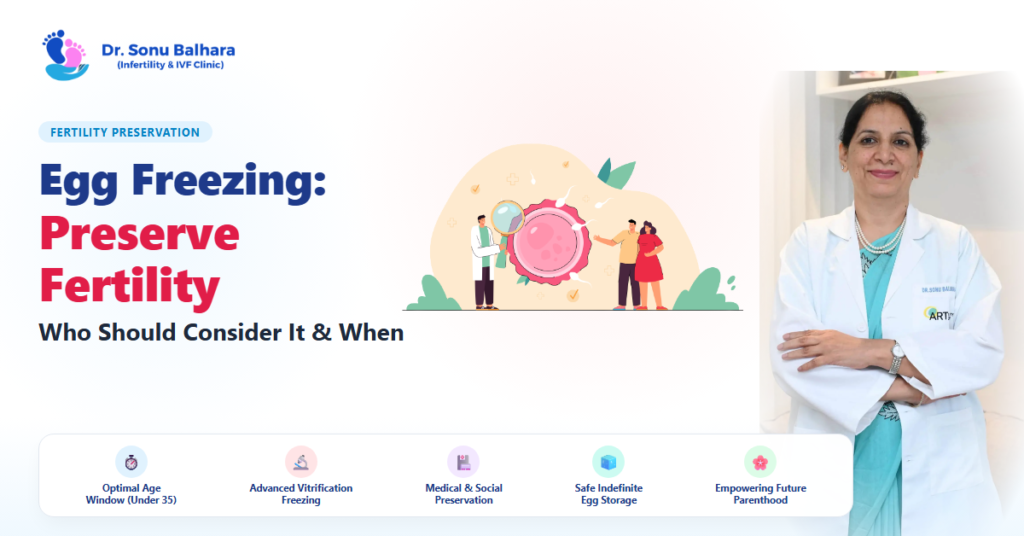
Egg freezing, medically known as oocyte cryopreservation, has moved from experimental to mainstream in just over a decade. In 2012, ASRM lifted the “experimental” label from egg freezing for non-oncological indications, following evidence from randomised controlled trials demonstrating outcomes comparable to fresh eggs.
Today, egg freezing offers women the possibility of extending their reproductive window — a decision that is deeply personal and needs careful, evidence-based counselling. Dr. Sonu Balhara regularly counsels women on this option at Nova IVF Fertility, Gurugram.
The Biology Behind Egg Freezing
The window of optimal egg quality and quantity is relatively narrow. AMH levels (a proxy for ovarian reserve) begin declining in the late 20s and fall more steeply after 35. Chromosomal errors (aneuploidy) in eggs increase with age — from approximately 10–15% in eggs from women in their 20s to over 50% by the early 40s (Gruhn et al., Science 2019).
The logic of egg freezing is simple: if you freeze eggs when they are young and chromosomally robust, you preserve the chance of a genetically normal embryo when you are ready to use them — even if that is years later.
Who Is a Good Candidate for Egg Freezing?
Medical Indications (Oncofertility)
The original and most medically urgent indication. Women facing chemotherapy, radiotherapy, or surgery that may damage ovarian function should be referred to a fertility specialist before treatment begins. ASCO guidelines (2019, updated 2023) note that oocyte cryopreservation is a standard, non-experimental fertility preservation option, and that all cancer patients of reproductive age should be counselled about fertility preservation before treatment.
Chemotherapy: alkylating agents (cyclophosphamide, busulfan) are most gonadotoxic; platinum compounds moderate risk
Radiotherapy: pelvic or total body irradiation carries high risk; cranial irradiation (hypothalamic-pituitary axis) also affects reproduction
Surgery: ovarian cystectomy, bilateral salpingectomy, oophorectomy for endometriosis or borderline tumours
Elective Social Egg Freezing
Women who do not currently have a partner, or who choose to delay childbearing for career, educational, or personal reasons. ASRM’s 2013 Committee Opinion (reaffirmed 2019) states that while egg freezing for social reasons remains ethically sound, women should be counselled that:
Success is not guaranteed, particularly if eggs are frozen after age 36–37
Egg freezing does not guarantee a future live birth — it preserves the possibility
Younger eggs freeze and thaw better; most fertility specialists recommend freezing before age 35, ideally before 32
Diminished Ovarian Reserve
Women diagnosed with low AMH or low AFC at a young age may choose to freeze eggs as a preservation strategy while they are still producing eggs, before reserve declines further.
Genetic Conditions
Women with Turner syndrome mosaicism, BRCA mutations (who plan prophylactic oophorectomy), or premature ovarian insufficiency in family members may consider egg freezing.
IVF Patients with No Partner
Women undergoing IVF without a partner can freeze eggs instead of embryos, preserving options for the future.
The Egg Freezing Process
Consultation and baseline tests: AMH, AFC, Day 2 FSH/LH, general health
- Ovarian stimulation: 10–14 days of injections (similar to IVF)
Monitoring: serial ultrasounds and blood tests every 2–3 days
Trigger injection: when follicles reach 16–18 mm
Egg collection: under sedation, ultrasound-guided transvaginal aspiration
Vitrification: mature (MII) eggs are vitrified immediately
Storage: in liquid nitrogen tanks, at -196°C
How Many Eggs Do You Need?
This is one of the most common questions Dr. Sonu Balhara receives. The honest answer depends on age and desired family size, using published data:
Per mature egg: approximately 3–8% chance of a live birth when used at age 38–40 (Rienzi et al., RBM Online 2017)
To achieve a 70–80% cumulative live birth chance for one child: approximately 10–15 mature eggs from a woman under 35
The older the woman at freeze time, the more eggs are needed to reach the same probability (eggs from women over 38 may require 20+ for comparable outcomes)
These are population-level estimates. Individual ovarian response determines how many can be retrieved per cycle; multiple cycles may be needed.
Egg Freezing Success Rates
Per mature oocyte thawed, fertilisation rates with ICSI are approximately 70–80%. Of fertilised eggs, approximately 50–60% develop to blastocyst. The key metric is per thawed mature egg live birth rate, which ESHRE data puts at approximately 3–5% for eggs frozen at 35–37 and 6–8% for eggs frozen under 35.
Ethical and Practical Considerations
What happens to unused eggs? Informed consent covers storage, donation, research use, or discard — following ART Act 2021 guidelines in India
Insurance: egg freezing is not currently covered by standard health insurance in India
Emotional aspects: the process involves hormone injections and uncertainty; support is important
Dr. Sonu Balhara‘s Guidance
“The best age to freeze eggs is a question I get often. The honest answer: in your late 20s to early 30s. The eggs are younger, more chromosomally normal, and you can freeze an adequate number in one or two cycles. Waiting until 38 or 39 is not too late — but you need realistic expectations and you should discuss your specific AMH with your doctor before deciding.” — Dr. Sonu Balhara, Nova IVF Fertility, Gurugram
References
- ASRM Committee Opinion (2013, reaffirmed 2019). Mature oocyte cryopreservation. Fertility & Sterility
- ASCO Guideline Update (2023). Fertility Preservation in Patients with Cancer
- Gruhn JR et al. (2019). Chromosome errors in human eggs shape natural fertility over reproductive life span. Science
- Rienzi L et al. (2017). Oocyte, embryo and blastocyst cryopreservation. RBM Online
Schedule a Consultation with Dr. Sonu Balhara
Whether you are exploring IVF options, considering embryo transfer protocols, or seeking a second opinion on fertility treatment in Gurgaon, Dr. Sonu Balhara provides personalized, compassionate, and transparent care backed by 25+ years of clinical excellence.
📍 Clinic: Nova IVF Fertility, Plot No. 522, near DLF Mega Mall, Sector-27, Gurugram
📞 Phone / WhatsApp: +91 9811409586 |
🌐 Website: sonubalharaivf.com