
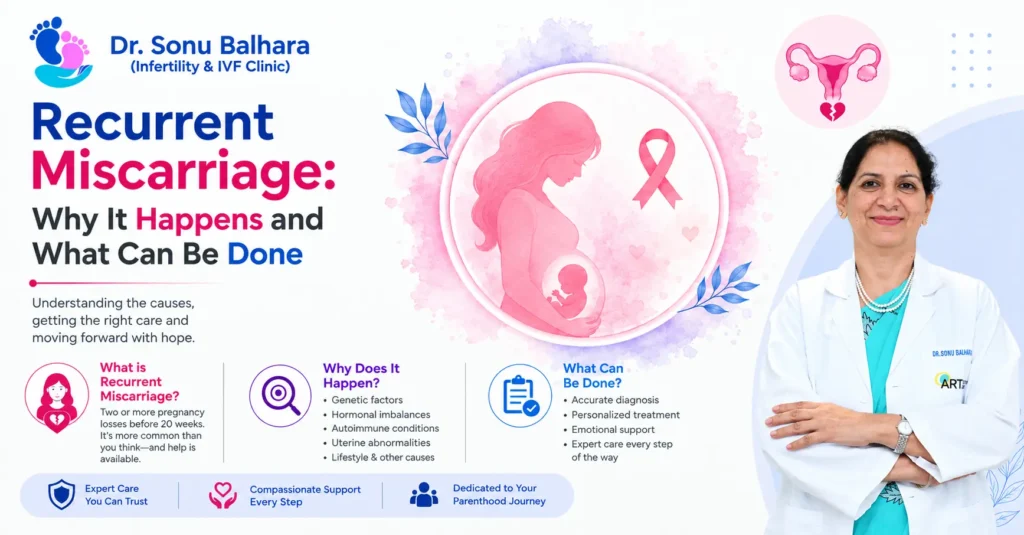
Losing a pregnancy once is heartbreaking. Losing it more than once — without answers, without a clear reason — is an experience that is difficult to put into words. Many couples go through this quietly, not knowing that recurrent miscarriage is a recognised medical condition with identifiable causes in many cases, and real treatment options.
Dr. Sonu Balhara, IVF and Fertility Expert at ART Fertility Clinics, Gurugram, sees couples navigating recurrent miscarriage from across India and internationally. Her approach is thorough, compassionate, and grounded in evidence. This blog explains what recurrent miscarriage is, why it happens, and what can be done.
What Is Recurrent Miscarriage?
Recurrent miscarriage is defined differently by different organisations. The American Society for Reproductive Medicine (ASRM) recommends clinical evaluation after two or more pregnancy losses. The Royal College of Obstetricians and Gynaecologists (RCOG) Green-top Guideline No. 17 (2023, BJOG) defines recurrent miscarriage as three or more pregnancy losses (first or second trimester) as the threshold for full investigation — not restricted to first trimester only. The European Society of Human Reproduction and Embryology (ESHRE) defines it as two or more losses.
It affects approximately 2 percent of couples when defined as two or more losses, and approximately 1 percent of couples when defined as three or more losses (Source: ASRM Committee Opinion 2026, Fertility & Sterility 2026;125:1023–41; Medscape, Emedicine 2025). Single miscarriage is much more common, occurring in around 12 to 15 percent of clinically recognised pregnancies. Recurrent miscarriage deserves proper investigation regardless of which definition applies to your situation.
What Causes Recurrent Miscarriage?
1. Chromosomal Abnormalities in the Embryo
The most common cause of individual miscarriages — and frequently of recurrent ones — is a chromosomal problem in the embryo. ASRM’s 2026 updated committee opinion notes that the majority of miscarriages result from genetic causes, which are significantly influenced by maternal age. As a woman gets older, the proportion of chromosomally abnormal embryos increases, which is why recurrent miscarriage becomes more common in women over 35.
Genetic testing of the pregnancy tissue — when possible — is now recommended by ASRM as a first step in evaluation after a loss.
2. Uterine Abnormalities
The shape and structure of the uterus matters significantly for pregnancy. Conditions that can cause recurrent miscarriage include:
- Uterine septum — a band of tissue dividing the uterine cavity. This is one of the most correctable structural causes
- Fibroids — particularly those that grow into the uterine cavity (submucosal fibroids)
- Polyps — small growths on the uterine lining
- Intrauterine adhesions — scar tissue inside the uterus, often from previous surgery
An evaluation of uterine anatomy is recommended for all women with recurrent miscarriage (ASRM 2026; RCOG Green-top Guideline 17, 2023).
3. Antiphospholipid Syndrome (APS)
APS is an immune condition where the body produces antibodies that increase the risk of blood clots, including in the placenta — which can cut off blood supply to the pregnancy. It is one of the most important treatable causes of recurrent miscarriage. Testing for antiphospholipid antibodies is recommended for all women with recurrent pregnancy loss.
When APS is identified, treatment with low-dose aspirin and low-molecular-weight heparin during pregnancy significantly improves outcomes.
4. Thyroid Disorders
Thyroid problems — both over and underactive — are associated with pregnancy loss. RCOG and ASRM both recommend thyroid function testing as part of the recurrent miscarriage workup. Treating thyroid disorders appropriately before and during pregnancy is an important step.
5. Parental Chromosomal Rearrangements
In a small number of couples, one partner carries a balanced chromosomal rearrangement — meaning their chromosomes are rearranged but they are personally unaffected. However, the embryos produced have a higher chance of chromosomal imbalance. A blood test (parental karyotyping) can identify this. ASRM and ESHRE recommend this be considered on an individual risk assessment basis.
6. Unexplained Recurrent Miscarriage
Even after thorough investigation, no clear cause is found in a significant proportion of couples — this is called unexplained recurrent miscarriage. This is frustrating, but it is important to know: ASRM’s updated 2026 guidance notes that 50 to 80 percent of patients with recurrent pregnancy loss will go on to have a successful pregnancy, even without specific medical intervention. Emotional support and counselling are considered a core part of care.
What Tests Are Done?
An evidence-based workup for recurrent miscarriage typically includes:
- Uterine assessment — ultrasound, saline infusion sonography (SIS), or hysteroscopy
- Antiphospholipid antibody testing — two tests at least 12 weeks apart to confirm
- Thyroid function tests
- Genetic testing of pregnancy tissue — when available (ASRM now recommends offering this to all patients after a loss)
- Parental karyotyping — considered based on individual history
- Blood sugar and general health screening
Dr. Sonu Balhara tailors the investigation to each couple’s specific history, the number and timing of losses, and individual clinical factors.
Treatment Options
Correcting Structural Problems
A uterine septum, submucous fibroid, or polyp found on investigation can often be removed via hysteroscopy — a minimally invasive procedure. This is one of the most directly effective interventions when a structural cause is identified.
Treatment for APS
Low-dose aspirin combined with low-molecular-weight heparin during pregnancy is the established treatment for APS-related recurrent miscarriage. This has been shown to significantly improve live birth rates.
PGT-A — Genetic Testing of Embryos Before Transfer
For couples who have experienced recurrent miscarriage and are proceeding with IVF, preimplantation genetic testing for aneuploidy (PGT-A) can identify chromosomally normal embryos before transfer — reducing the risk of another chromosomally abnormal pregnancy. This is particularly relevant for women over 35.
Thyroid Treatment
Where thyroid disorders are identified, appropriate medication before and during pregnancy can reduce the risk of further loss.
Emotional and Psychological Support
ASRM, RCOG, and ESHRE all explicitly recognise that emotional support and counselling are a core and necessary part of recurrent miscarriage care — not an optional add-on. The emotional burden of repeated loss is real and should be addressed alongside medical treatment.
When Should You Seek Help?
You should seek a specialist evaluation if you have had two or more pregnancy losses. Do not wait for a third. Earlier investigation means earlier answers and earlier treatment. Dr. Sonu Balhara offers specialist recurrent miscarriage evaluation at ART Fertility Clinics, Sector 38, Gurugram, and via video consultation for patients based internationally.
Dr. Sonu Balhara | IVF & Fertility Expert | ART Fertility Clinics, Sector 38, Gurugram | Personal Clinic: Sector 46, Greenwood City, Gurugram | +91 9811409586 | sonubalharaivf.com
Conclusion
Recurrent miscarriage is not simply ‘bad luck’ — in many cases there is an identifiable and treatable cause. And even in cases where no cause is found, the evidence shows that most couples do go on to have a successful pregnancy with the right medical support and care.
If you have experienced more than one miscarriage, you deserve answers, not silence. Book a consultation with Dr. Sonu Balhara at ART Fertility Clinics, Sector 38, Gurugram.