
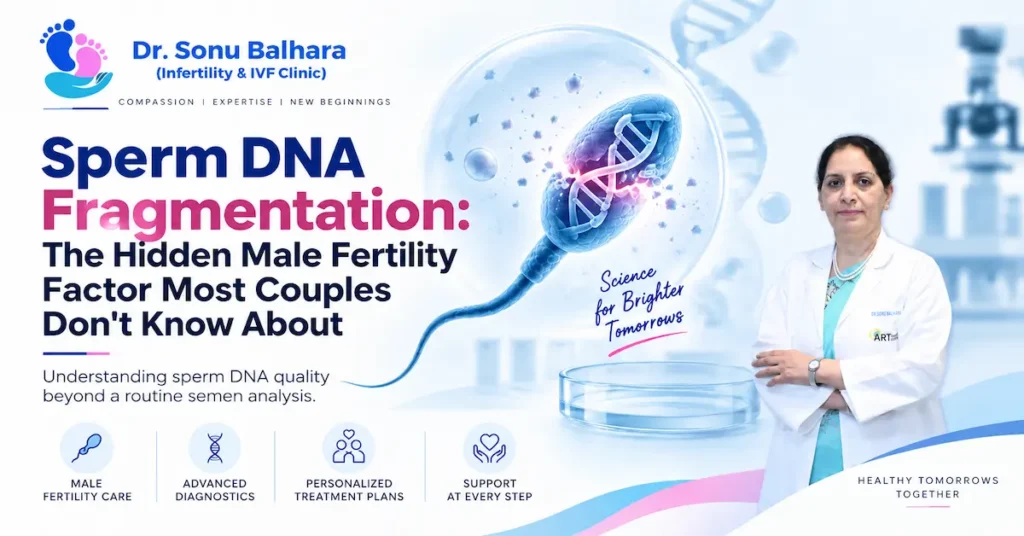
A semen analysis comes back normal. Count — good. Motility — good. Morphology — acceptable. And yet IVF keeps failing. Or recurrent miscarriages keep happening. Or fertilisation rates are consistently low.
In many of these cases, the answer lies in something a standard semen analysis does not measure: sperm DNA fragmentation.
Dr. Sonu Balhara, IVF and Fertility Expert at ART Fertility Clinics, Gurugram, presented research on recurrent implantation failure at the Indian Fertility Society’s 8th National Conference (2012). Male-side factors — including DNA fragmentation — were a key part of that research. She investigates this specifically in couples where standard evaluation has not provided answers.
What Is Sperm DNA Fragmentation?
Inside each sperm, there is a DNA package — the genetic information it carries to the egg. DNA fragmentation refers to breaks or damage in this DNA strand. The sperm may look completely normal and swim normally — the standard semen analysis assesses appearance and movement, not DNA integrity.
A sperm with high DNA fragmentation can still fertilise an egg. But the damaged DNA it carries can affect the embryo’s ability to develop normally — leading to fertilisation failure, poor quality embryos, implantation failure, or early pregnancy loss.
How Common Is It?
DNA fragmentation is found in varying degrees in all men. A fragmentation index (DFI) below 15 to 20 percent is generally considered normal — though different laboratories and assay methods may use slightly different thresholds. Above 25 to 30 percent is considered high and is associated with reduced fertility outcomes.
Note: The 2024 updated AUA/ASRM Male Infertility Guideline does not recommend DNA fragmentation testing as a routine initial test for all infertile men. However, it notes that clinicians may consider it in specific situations — and the WHO’s 6th edition semen analysis manual has acknowledged SDF testing as part of the extended semen examination panel available at clinical discretion.
When Is DNA Fragmentation Testing Considered?
Based on current clinical guidelines (AUA/ASRM 2024; WHO 2021), DNA fragmentation testing is considered appropriate in:
- Unexplained infertility — where all standard tests are normal
- Recurrent miscarriage — where the male factor may be contributing
- Recurrent IVF failure — particularly where fertilisation rates have been poor or embryo quality has been consistently low
- Prior to IVF or ICSI — in men with known risk factors for high oxidative stress
- Men with a varicocele (dilated veins in the scrotum) — varicocele is associated with elevated DNA fragmentation
- Before sperm freezing for fertility preservation
What Causes High Sperm DNA Fragmentation?
- Oxidative stress — the most common cause; caused by smoking, alcohol, obesity, high heat exposure, and environmental pollutants
- Varicocele — the dilated veins raise scrotal temperature, increasing oxidative damage to sperm DNA
- Infection or inflammation of the reproductive tract
- Age — DNA fragmentation increases gradually with age in men, though less dramatically than egg quality decline in women
- Certain medications and cancer treatments
Can High DNA Fragmentation Be Treated?
Yes — in many cases. Treatment depends on the underlying cause:
- Lifestyle changes: Stopping smoking, reducing alcohol, losing weight, avoiding heat to the groin area (tight clothing, hot baths, laptops on the lap) — these directly reduce oxidative stress and can improve DFI over 3 to 6 months
- Antioxidant supplements: There is some evidence supporting antioxidant supplementation (Vitamin C, Vitamin E, selenium, zinc, CoQ10) to reduce oxidative damage to sperm. However, ASRM notes that evidence is not yet conclusive enough to make a standard recommendation — use only under medical supervision
- Treating varicocele: Surgical or radiological treatment of varicocele can reduce DFI and improve sperm quality
- Testicular sperm retrieval: When DNA fragmentation in ejaculated sperm is very high, sperm retrieved directly from the testis (TESA) tends to have lower fragmentation — because testicular sperm has not been exposed to the same oxidative environment as ejaculated sperm. The 2024 AUA/ASRM Guideline notes that clinicians may consider the utilisation of testicular sperm in nonazoospermic males with elevated DFI (Moderate Recommendation, Grade C evidence)
How Is DNA Fragmentation Tested?
The most commonly used tests include the TUNEL assay, SCSA (Sperm Chromatin Structure Assay), and SCD (Sperm Chromatin Dispersion) test. These are available at specialised fertility laboratories. The test requires a semen sample produced at the clinic.
A Note on Evidence
Sperm DNA fragmentation testing is an evolving area of male fertility research. It is not yet a standard first-line test. The evidence for its impact on ART outcomes continues to develop. Dr. Sonu Balhara uses this investigation selectively — in cases where the clinical picture suggests it may provide useful information — rather than routinely for every patient.
Dr. Sonu Balhara | IVF & Fertility Expert | ART Fertility Clinics, Sector 38, Gurugram | Personal Clinic: Sector 46, Greenwood City, Gurugram | +91 9811409586 | sonubalharaivf.com
Conclusion
Sperm DNA fragmentation is a real and important male fertility factor that standard semen analysis does not detect. In cases of unexplained infertility, recurrent miscarriage, or repeated IVF failure with normal semen parameters, it is worth investigating. Treatment options exist and can make a meaningful difference.
If you are in any of these situations, book a consultation with Dr. Sonu Balhara at ART Fertility Clinics, Sector 38, Gurugram.