
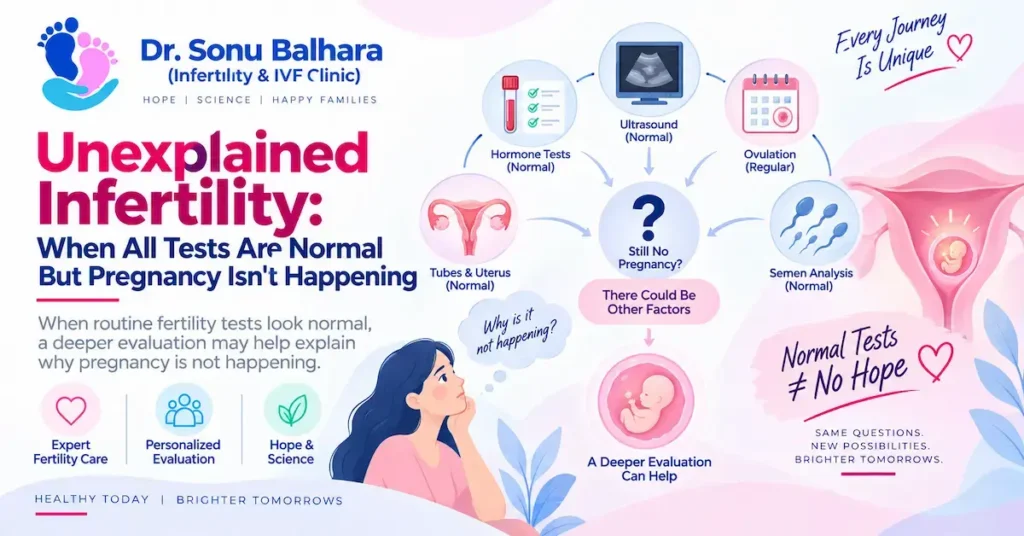
You have done every test. Hormones — normal. Fallopian tubes — open. Semen analysis — normal. Uterus — fine. Everything looks perfectly in order, and yet — no pregnancy. The doctor says the words: ‘unexplained infertility.’
For many couples, this is more distressing than receiving a clear diagnosis. At least with a diagnosis, there is something to treat. What do you do when there is nothing to find?
Dr. Sonu Balhara, IVF and Fertility Expert at ART Fertility Clinics, Gurugram, explains what unexplained infertility actually means, why it is not the same as ‘nothing is wrong,’ and what the treatment pathway looks like.
What Is Unexplained Infertility?
Unexplained infertility is a diagnosis of exclusion. According to ESHRE’s evidence-based guideline on unexplained infertility (2023), it is diagnosed when a couple has been unable to conceive despite:
- Normal ovarian function — regular ovulation confirmed
- Normal fallopian tubes — open and functioning
- Normal semen analysis — count, motility, and morphology within WHO reference values
- No anatomical problems with the uterus
Unexplained infertility is not rare. ESHRE’s 2023 guideline notes that up to 50 percent of couples seeking fertility assistance may be diagnosed with unexplained infertility. This is one of the most common fertility diagnoses a couple receives.
Why Does It Happen If Everything Looks Normal?
The standard fertility tests assess the most visible, measurable factors. But reproduction is extraordinarily complex. Several things that can affect fertility are not captured by basic tests:
- Egg quality — a semen analysis tells us nothing about egg quality; age is the primary indicator but quality varies individually
- Sperm function beyond standard analysis — DNA fragmentation, for example, is not part of routine semen analysis but can affect fertilisation and embryo development
- Fertilisation problems — some eggs and sperm simply do not fertilise even when all parameters appear normal
- Subtle endometrial receptivity issues — the uterine lining may not be optimally receptive even when it looks normal on ultrasound
- Immunological factors — still being researched and not routinely tested
The word ‘unexplained’ is not the same as ‘unsolvable.’ It means the current standard tests have not identified a specific cause — not that no cause exists.
Does Pregnancy Happen Naturally with Unexplained Infertility?
Yes — and this is important to understand. ESHRE’s 2023 guideline acknowledges that natural conception remains a possibility for couples with unexplained infertility. The probability of natural conception depends on how long the couple has been trying, the woman’s age, and other individual factors.
However, waiting indefinitely is not always the right strategy — particularly for women over 35 where the decline in egg quality accelerates each year. This is why a prognosis-based approach — understanding each couple’s individual likelihood of natural conception — is important in deciding how long to try naturally before beginning treatment.
Treatment Options for Unexplained Infertility
IUI with Ovarian Stimulation — First-Line Treatment
ESHRE’s 2023 evidence-based guideline on unexplained infertility recommends IUI (Intrauterine Insemination) in combination with ovarian stimulation as first-line treatment for couples with unexplained infertility. IUI increases the number of eggs available and places concentrated sperm directly at the right place — addressing two of the potential hidden factors at once.
IVF
If IUI cycles are unsuccessful, or if the woman is over 37 to 38, or if there is a time-sensitive reason to move more quickly — IVF is the next step. IVF effectively bypasses many of the processes that may be subtly failing in unexplained infertility. The embryo is created in the laboratory and placed directly in the uterus, removing the egg-sperm meeting and fertilisation steps from the equation.
IVF also gives the doctor much more information — about how many eggs respond, how many fertilise, and how the embryos develop — which can itself help identify what has been ‘unexplained.’
IVF with ICSI
If previous standard IVF showed poor fertilisation despite good egg and sperm quality, IVF with ICSI — where a single sperm is injected into each egg — may be recommended to improve fertilisation rates.
PGT-A
For older women with unexplained infertility, testing embryos genetically before transfer (PGT-A) can help identify chromosomally normal embryos and improve the chance of a successful implantation.
What Should You Not Do?
Do not spend years on treatments that are unlikely to work for your specific situation. Dr. Sonu Balhara frequently sees couples who have had many cycles of one treatment without success before being referred. The ESHRE and ASRM guidelines both emphasise that the treatment approach should be tailored to the couple’s age, duration of infertility, and individual clinical picture.
A Note on Emotional Impact
‘Unexplained’ can feel like an unsatisfying answer. It is worth acknowledging that living with uncertainty — not knowing why something is not happening when everything ‘should’ be fine — is emotionally exhausting. Counselling and emotional support are a recognised part of fertility care for couples with unexplained infertility.
Dr. Sonu Balhara | IVF & Fertility Expert | ART Fertility Clinics, Sector 38, Gurugram | Personal Clinic: Sector 46, Greenwood City, Gurugram | +91 9811409586 | sonubalharaivf.com
Conclusion
Unexplained infertility is one of the most common fertility diagnoses — and one of the most treatable. IUI with stimulation is the recommended first step. IVF is highly effective when first-line treatment is not successful. The right approach depends on age, duration of trying, and individual factors.
If you have been told your tests are normal but pregnancy is not happening, book a consultation with Dr. Sonu Balhara at ART Fertility Clinics, Sector 38, Gurugram. Normal tests do not mean no options.