When a couple has been trying to conceive without success, the word “laparoscopy” often comes up at some point during investigations. For many patients of Dr. Sonu Balhara at ART Fertility Clinics, Gurugram — including those who have travelled from Iraq, Iran, England, Nigeria, Kenya, Singapore and beyond — the question is the same: is laparoscopy necessary before IVF? And what can it actually achieve?
This blog explains what laparoscopy is, what it can diagnose and treat, and when it genuinely helps fertility — based on current international guidelines.
What Is Laparoscopy?
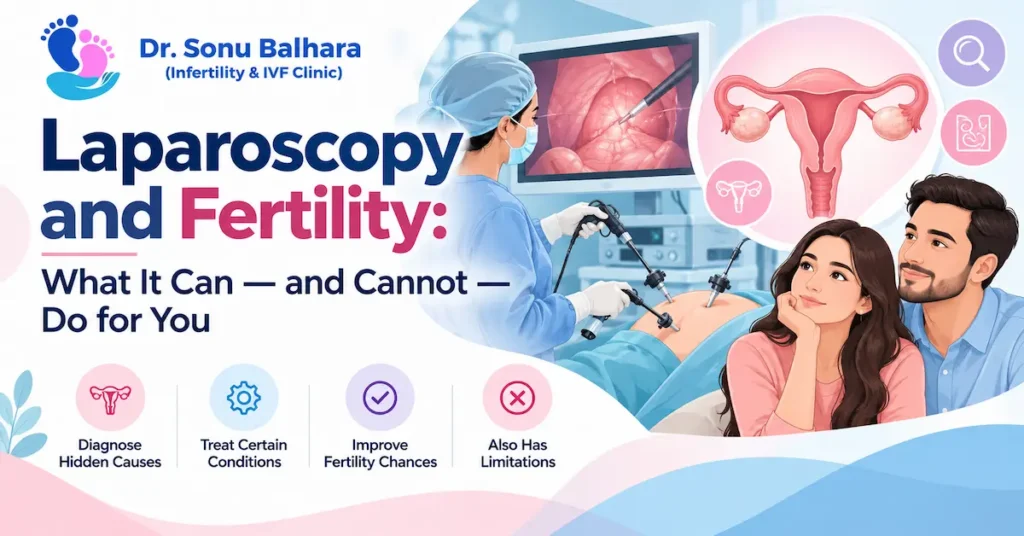
Laparoscopy is a minimally invasive surgical procedure performed under general anaesthesia. A thin camera (laparoscope) is inserted through a small incision near the navel, allowing the surgeon to see the pelvis — uterus, tubes, ovaries, and surrounding structures — directly on a screen. Instruments passed through additional small incisions can simultaneously diagnose and treat many conditions.
Because it provides direct visualisation, laparoscopy is considered the gold standard diagnostic tool for several causes of infertility that cannot be confirmed by ultrasound or blood tests alone.
What Can Laparoscopy Diagnose?
- Endometriosis (including early-stage deposits not visible on scan)
- Peritubal and pelvic adhesions (scar tissue blocking or distorting the tubes)
- Blocked fallopian tubes (confirmed with dye test — chromotubation)
- Ovarian cysts and endometriomas (chocolate cysts)
- Uterine abnormalities such as a septum, fibroids on the outer uterus
- Polycystic ovaries (if laparoscopic drilling is being considered)
What Can Operative Laparoscopy Treat?
This is the key distinction: diagnostic laparoscopy only looks; operative laparoscopy both looks and treats.
- Excision or ablation of endometriosis deposits
- Division of pelvic adhesions to restore normal anatomy
- Removal of endometriomas (preserving healthy ovarian tissue where possible)
- Ovarian drilling for PCOS resistant to medication
- Salpingectomy (removal of a blocked, fluid-filled tube — a hydrosalpinx — before IVF)
Does Laparoscopy Improve Pregnancy Rates? What the Evidence Says
For endometriosis:
A landmark study and subsequent meta-analyses have shown that operative laparoscopy — excision of stage I and II endometriosis deposits — improves ongoing pregnancy rates compared to diagnostic laparoscopy alone. (Best Practice & Research Clinical Obstetrics & Gynaecology, 2024.) However, for severe (stage III–IV) endometriosis, the evidence is less clear-cut and IVF is often the preferred route.
For hydrosalpinx (blocked, fluid-filled tube):
Removing a damaged hydrosalpinx before IVF significantly improves IVF success rates. The fluid from a damaged tube can be toxic to embryos. This is one of the clearest evidence-based indications for laparoscopy before IVF. (ESHRE Endometriosis Guideline, 2022.)
For unexplained infertility:
ESHRE guidelines (2022) no longer recommend routine diagnostic laparoscopy as a first-line investigation in unexplained infertility. Evidence does not support that routine laparoscopy improves pregnancy outcomes in women with no identified abnormality on non-invasive testing.
When Does Dr. Sonu Balhara Recommend Laparoscopy?
With over 25 years of experience in reproductive medicine, Dr. Sonu Balhara individualises every recommendation. Laparoscopy is not a routine step before every IVF cycle. It is recommended when:
- Ultrasound or HSG suggests a blockage, distortion, or anatomical problem
- Endometriosis is suspected based on symptoms (severe dysmenorrhoea, deep dyspareunia, chronic pelvic pain) but not confirmed by scan
- A hydrosalpinx is seen on scan before IVF
- Recurrent IVF failure is being investigated and a pelvic cause has not been excluded
- Ovarian cysts are present that may compromise egg collection
In many cases, a thorough pelvic ultrasound, blood tests, and hysteroscopy provide sufficient information — and the couple can move forward without surgery.
Laparoscopy and IVF: Not Always a Sequence
A common misconception is that laparoscopy must always precede IVF. In reality, for many couples — especially those with reduced ovarian reserve, advanced female age, or severe male factor — proceeding directly to IVF is the more time-efficient and evidence-based approach. Every month counts. Dr. Sonu Balhara’s protocol is to recommend surgery only when it is likely to directly improve the chance of conception, not as a default step.
Recovery and What to Expect
- Most laparoscopic procedures are day surgeries or require one overnight stay
- Return to normal activity: typically 5–7 days
- Full recovery before starting fertility treatment: usually 4–6 weeks
- Minimal scarring (2–3 small incisions, each under 1 cm)
Questions to Ask Your Surgeon
- Is this laparoscopy diagnostic only, or will you treat what you find?
- What specific diagnosis are you trying to confirm — and how will the result change my treatment plan?
- If laparoscopy finds nothing, what is the next step?
- Could we proceed to IVF first and consider laparoscopy only if IVF fails?
Conclusion
Laparoscopy is a valuable tool in the investigation and treatment of infertility — but it is not a universal requirement. For patients consulting Dr. Sonu Balhara at ART Fertility Clinics, Gurugram, every decision about surgery is made after a thorough review of investigations, clinical history, and the couple’s specific fertility goals. The aim is always the most direct and evidence-based path to pregnancy.
To discuss whether laparoscopy is right for your situation, book a consultation with Dr. Sonu Balhara at ART Fertility Clinics, Sector 38, Gurugram, or her personal clinic in Greenwood City, Sector 46.
Dr. Sonu Balhara | IVF & Fertility Expert | | +91 9811409586 | sonubalharaivf.com