Uterine fibroids — non-cancerous growths in the muscle of the uterus — are extremely common. Studies suggest that up to 70–80% of women will develop fibroids by the age of 50. (ASRM Practice Committee, 2017.) Yet most women with fibroids have no symptoms and conceive without difficulty. So why do fibroids matter in fertility — and when do they need treatment?
Dr. Sonu Balhara, IVF specialist at ART Fertility Clinics, Gurugram, explains.
What Are Fibroids?
Fibroids (also called leiomyomas or myomas) are benign tumours made of smooth muscle and connective tissue that grow within or on the wall of the uterus. They range from the size of a pea to — in rare cases — the size of a grapefruit. They are not cancerous and do not increase the risk of uterine cancer.
Types of Fibroids — Location Determines Everything
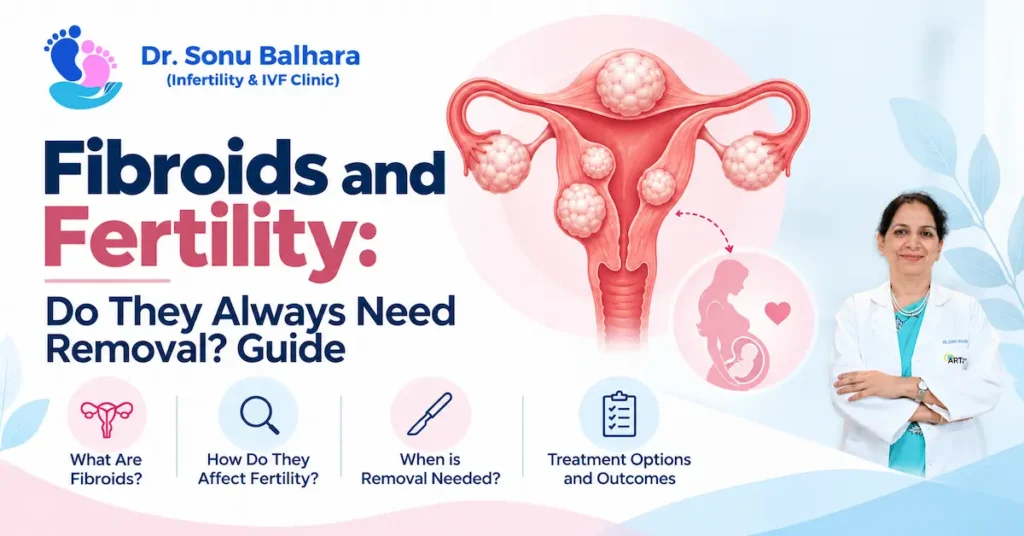
The location of a fibroid within the uterus is the most important factor in deciding whether it affects fertility:
Submucosal fibroids
These grow into the uterine cavity (the space where the embryo implants and grows). Even small submucosal fibroids have the strongest evidence for reducing fertility and increasing miscarriage rates. The ASRM Practice Committee (2017) states that submucosal fibroids should be surgically removed before attempting conception or IVF. Removal is performed by hysteroscopy — a minimally invasive procedure with no external cuts.
Intramural fibroids
These grow within the muscle wall of the uterus. Their effect on fertility depends on their size and whether they distort the uterine cavity. Large intramural fibroids (generally above 4–5 cm) that distort the cavity are associated with reduced IVF success. Smaller intramural fibroids that do not impinge on the cavity are less likely to affect fertility.
Subserosal fibroids
These grow on the outer surface of the uterus. According to ASRM (2017), subserosal fibroids have no significant impact on fertility or IVF outcomes and generally do not require removal before fertility treatment — unless they are very large and are compressing other structures.
Symptoms That May Indicate Fibroids
- Heavy or prolonged menstrual bleeding
- Pelvic pressure or a sense of fullness
- Frequent urination (if a fibroid is pressing on the bladder)
- Pain during menstruation or intercourse
- Recurrent miscarriage
Importantly, many fibroids cause no symptoms at all and are found incidentally during a fertility scan.
How Are Fibroids Diagnosed?
Transvaginal ultrasound is the standard first-line investigation. It is highly accurate for detecting and locating fibroids. A saline infusion sonohysterography (SIS) or hysteroscopy may be used to better visualise the uterine cavity and assess whether a fibroid is submucosal. MRI is sometimes used for larger or multiple fibroids to map their exact location and size before surgery.
When Should Fibroids Be Treated Before IVF?
Dr. Sonu Balhara follows evidence-based guidelines in her recommendations:
- Submucosal fibroids — remove before IVF (strong evidence; ASRM 2017)
- Intramural fibroids >4–5 cm distorting the cavity — consider removal
- Intramural fibroids not distorting the cavity — close monitoring; removal not routinely required
- Subserosal fibroids — removal generally not required before fertility treatment
How Are Fibroids Removed?
Hysteroscopic myomectomy
For submucosal fibroids — performed through the cervix with no abdominal incision. Recovery is rapid (1–2 weeks). This is the preferred approach.
Laparoscopic myomectomy
For intramural or subserosal fibroids — keyhole surgery through the abdomen. Recovery is 2–4 weeks. Preserves the uterus completely.
Open (abdominal) myomectomy
Reserved for very large or multiple fibroids where laparoscopic surgery is not feasible.
Do Fibroids Return After Removal?
Myomectomy removes existing fibroids but does not prevent new ones from forming. For women who plan to conceive after surgery, the advice is typically to attempt conception within 12–18 months of recovery — before new fibroids develop.
Fibroids and Pregnancy After IVF
For women with fibroids who do become pregnant, fibroids may grow during pregnancy under the influence of hormones. However, most pregnancies with fibroids proceed without complications. Risks such as placenta previa, premature labour, or caesarean section depend on fibroid location and size, and are assessed individually.
Conclusion
Not all fibroids need to be removed before IVF. Location is the decisive factor. Dr. Sonu Balhara’s approach at ART Fertility Clinics, Gurugram is thorough, individualised assessment — acting on fibroids when the evidence supports it, and avoiding unnecessary surgery when it does not.
If fibroids have been found during your fertility investigations, book a consultation with Dr. Sonu Balhara at ART Fertility Clinics, Sector 38, Gurugram or Greenwood City, Sector 46.
Dr. Sonu Balhara | IVF & Fertility Expert | | +91 9811409586 | sonubalharaivf.com