
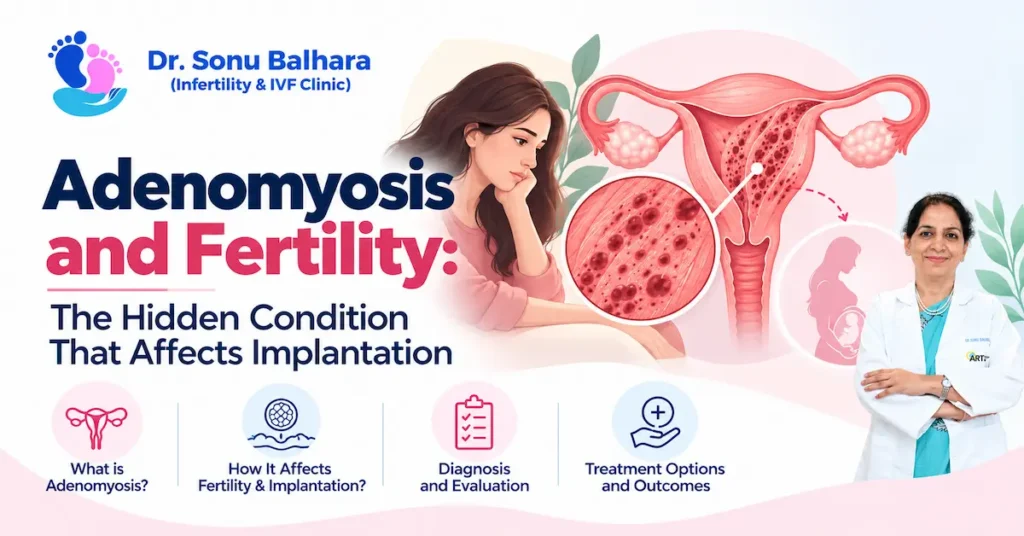
Adenomyosis is a condition in which the tissue that normally lines the inside of the uterus (the endometrium) grows into the muscular wall of the uterus (the myometrium). It can cause painful, heavy periods — but it can also be entirely silent. And in the context of infertility, it is increasingly recognised as an important — and often overlooked — factor.
Dr. Sonu Balhara, IVF & Fertility Expert at ART Fertility Clinics, Gurugram, explains what adenomyosis is, how it affects the chances of pregnancy, and what can be done about it.
How Common Is Adenomyosis in Women with Infertility?
Adenomyosis has historically been considered a condition of older women who have had children. This perception has changed. It is now found in 8–27% of women presenting with infertility. (Medicina, 2023.) With better ultrasound technique and increasing use of MRI, more cases are being identified in younger, nulliparous (never pregnant) women.
How Does Adenomyosis Affect Fertility?
The mechanisms are multiple:
- Disrupted uterine peristalsis — the wave-like movements of the uterus that help sperm and embryos reach the right location
- Impaired endometrial receptivity — the lining may not be in optimal condition for implantation
- Local inflammatory changes — adenomyosis creates a chronic low-grade inflammatory environment
- Altered endometrial gene expression — changes at a molecular level that affect implantation
A meta-analysis by Nirgianakis et al. (2021) found that women with adenomyosis had significantly lower clinical pregnancy rates (OR 0.69) and significantly higher miscarriage rates (OR 2.17) compared to controls in IVF cycles.
Symptoms — But Often None
- Heavy, painful periods (dysmenorrhoea)
- A bulky, tender uterus on examination
- Pelvic pain outside of menstruation
- Recurrent early miscarriage
Up to 35% of women with adenomyosis have no symptoms. This is why it is frequently an incidental finding on fertility investigations.
How Is Adenomyosis Diagnosed?
Transvaginal ultrasound (TVS)
The first-line investigation. An experienced sonographer can identify features such as asymmetric thickening of the uterine wall, heterogeneous myometrium, myometrial cysts, and subendometrial striations. Sensitivity and specificity improve significantly with operator experience.
MRI
Considered the most accurate non-invasive test for adenomyosis. It shows the junctional zone — the boundary between the endometrium and myometrium — clearly, and is particularly helpful when ultrasound findings are equivocal or when the extent of involvement needs to be mapped before surgery.
There is no blood test for adenomyosis. Definitive diagnosis requires histology (microscopic examination of uterine tissue), but biopsy is rarely needed for clinical management.
Adenomyosis and IVF — Current Evidence
The First Lugano Workshop on Adenomyosis (RBMO, 2024) provided updated consensus guidance on adenomyosis in assisted reproduction. Key points:
- Women with adenomyosis undergoing IVF have lower live birth rates compared to those without the condition
- Frozen embryo transfer (FET) in an artificial cycle does not appear to significantly improve outcomes over fresh transfer in all cases — the evidence is still evolving
- The impact of adenomyosis may be greater in women with focal or diffuse disease involving a large proportion of the myometrium
Treatment Options for Adenomyosis Before or During IVF
GnRH agonist (Lupron / leuprolide acetate) downregulation
A prolonged course of GnRH agonist before IVF (3–6 months) can reduce the size and activity of adenomyotic tissue and improve endometrial receptivity. This is one of the most commonly used approaches in women with adenomyosis before embryo transfer. Evidence supports improved implantation rates in some studies (PMC 10201963).
Hormonal suppression
Progestins and the levonorgestrel intrauterine system (Mirena IUD) can reduce adenomyosis-related symptoms and, potentially, the local inflammatory environment. Their role before IVF is under ongoing study.
Surgery
Surgical removal of adenomyotic lesions (adenomyomectomy) is technically difficult and carries risks of uterine damage. It is generally reserved for severe, focal adenomyosis in younger women with recurrent IVF failure. It is not a routine first-line recommendation before IVF.
Dr. Sonu Balhara’s Approach
Dr. Sonu Balhara has extensive experience managing adenomyosis in the context of IVF, including in patients travelling from Sudan, Iran, Uzbekistan, Afghanistan, Bangladesh, and other countries for treatment at ART Fertility Clinics, Gurugram. Her approach involves:
- Thorough assessment with TVS and MRI where indicated
- Individualised pre-IVF preparation, which may include GnRH agonist downregulation
- Careful endometrial assessment before embryo transfer
- Frozen embryo transfer protocols when appropriate
- Recurrent implantation failure workup in cases of repeated unsuccessful cycles
Conclusion
Adenomyosis is not a barrier to pregnancy — but it requires careful planning. With the right assessment and preparation, women with adenomyosis can and do achieve successful pregnancies with IVF. The key is specialist expertise and an individualised approach.
If adenomyosis has been found during your investigations, or you have been experiencing heavy, painful periods alongside difficulty conceiving, consult Dr. Sonu Balhara at ART Fertility Clinics, Sector 38, Gurugram or Greenwood City, Sector 46.